Page content
View related multimedia and linksCooper
Ancient trade
The art of coopering dates back centuries, and the basic trade has remained unchanged. Coopering requires skill, intelligence, and strength. The tools of the trade are often handed down for generations.
Coopers crafted casks which:
- Held flour, gunpowder, tobacco, and other commodities
- Served as shipping containers
- Stored liquids from wine to milk
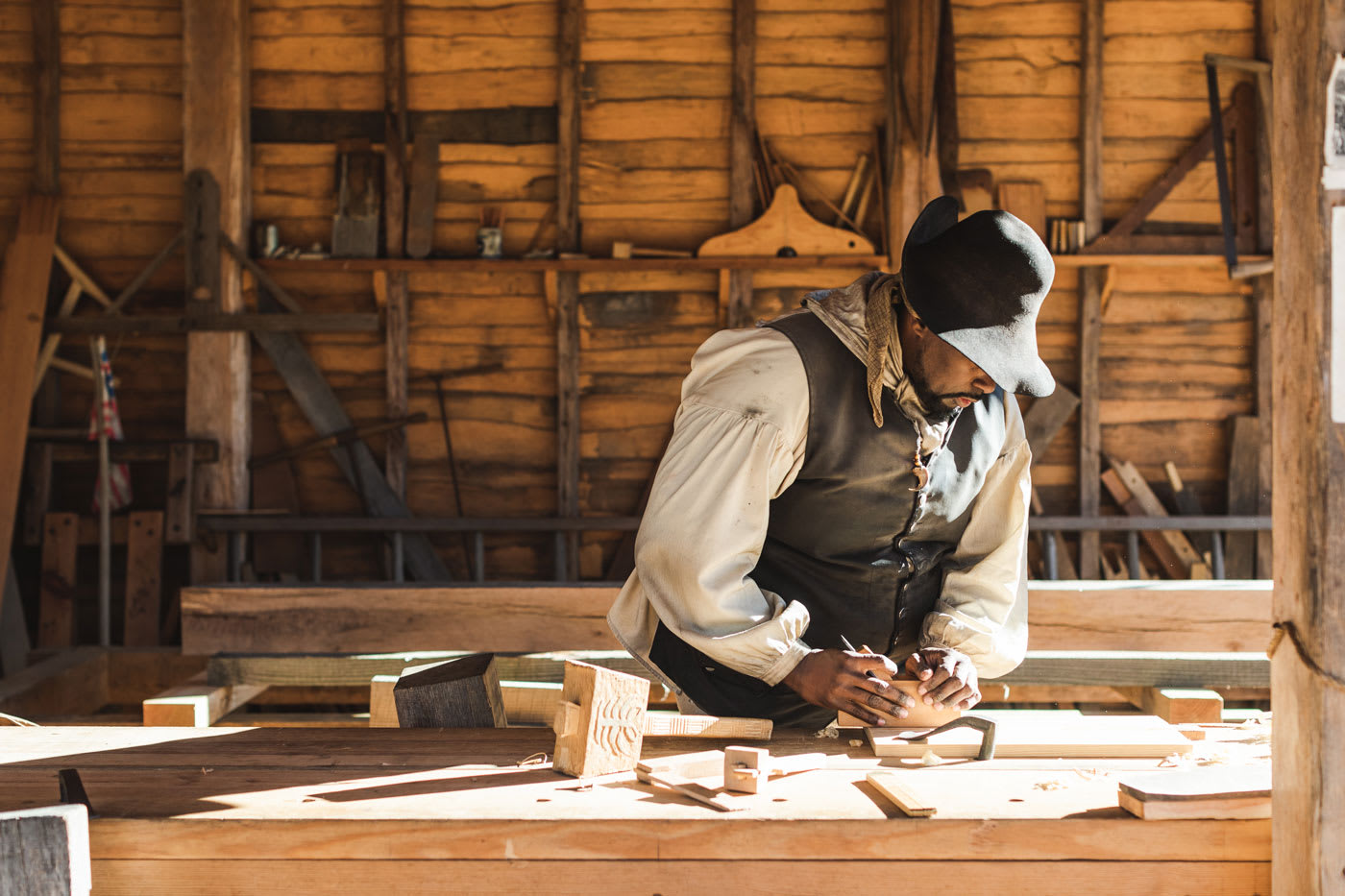
Many colonial coopers worked on plantations to produce the many hogsheads needed to ship tobacco from Virginia to Great Britain. Other coopers worked in towns like Williamsburg, turning staves and hoops into everything from butter churns to tubs. Large plantations often trained slaves in the trade. Coopers could also be found on military and merchant vessels, since casks were common aboard ships.
Finest casks held liquid
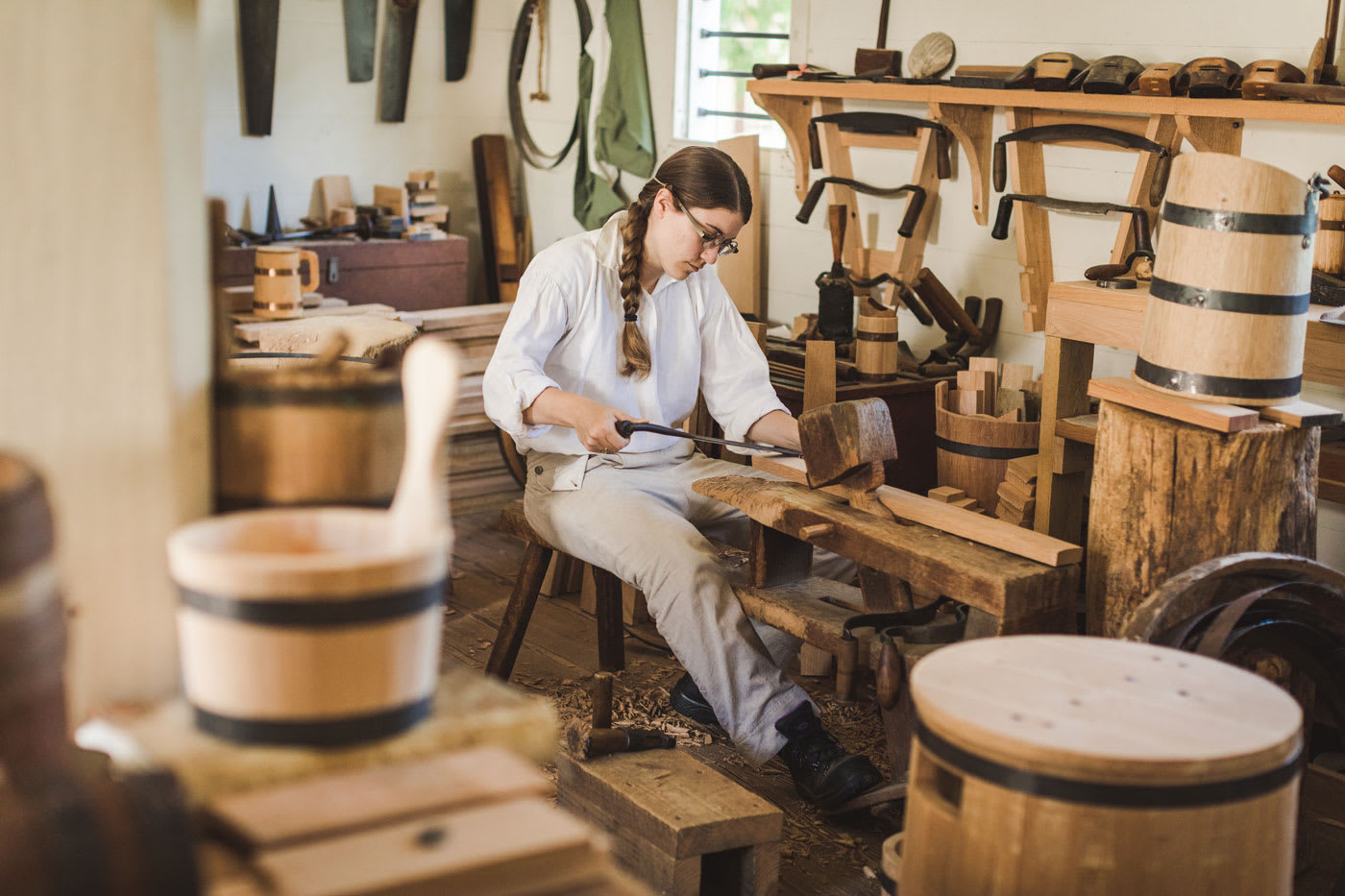
Today, coopers are often called "barrel makers," but a barrel is only one kind of cask, one made by what was known as a "tight cooper." Other casks included the firkin, kilderkin, hogshead, butt, rundlet, tierce, puncheon, and pipe. The tight cooper assembled clear white oak staves split from the dense center of a tree. He fit the staves one to another, and bound them with iron to make casks for liquids of all sorts.
A "slack cooper" built containers for such commodities as flour and tobacco. "White" coopering produced pails, churns, tubs, and dippers, often made of cedar or pine.
Casks, barrels, buckets, and pails found throughout Williamsburg
The coopers in the Historic Area of Colonial Williamsburg shape their staves with broadaxes, planes, and drawknives, and then gather them in a circle secured by a ring. The gathered staves are heated over a small stove or cresset to make them pliant and the heated staves are then bent into shape. Hickory hoops hold them for banding. The trickiest step is cutting grooves inside the lips to fit the barrelheads tightly. Today, the coopering trade is alive and well in Colonial Williamsburg and the results of the coopers' work can be seen throughout the Historic Area.
Learn more:Multimedia and related links
-
Podcasts
- View descriptions
-
Making Barrels
Ramona Vogel's love of woodworking led her to the Worshipful Company of Coopers. March 27, 2006
Audio podcast: Listen (mp3) | Transcript
Image enhanced: View (m4a) | Transcript
-
Coopering
Apprentice cooper Marshall Scheetz discusses the art and science of making barrels. July 18, 2005
Audio podcast: Listen (mp3) | Transcript
Image enhanced: View (m4a) | Transcript
-
A Slave's Perspective
The Declaration of Independence was a promise extended to white men only. Hope Smith portrays Eve, a slave in the Peyton Randolph house. July 16, 2007
Audio podcast: Listen (mp3) | Transcript
Image enhanced: View (m4a) | Transcript
-
The Slave Trade
The slave trade touched the lives of people around the globe, explains Colonial Williamsburg's Educational Program Development director Bill White. February 9, 2007
Audio podcast: Listen (mp3) | Transcript
Image enhanced: View (m4a) | Transcript
-
Mr. Wythe's Cook
Valarie Holmes interprets Lydia Broadnax - a cook for one of Williamsburg's most influential men. June 19, 2006
Audio podcast: Listen (mp3) | Transcript
Image enhanced: View (m4a) | Transcript
-
Emily James interprets spirited women
Jamaican-born Emily James has interpreted at least 16 different 18th-century women who learned how to survive lives of enslavement. February 27, 2006
Audio podcast: Listen (mp3) | Transcript
Image enhanced: View (m4a) | Transcript
- more...
- Quicktime 7 (free) is required to view the enhanced and video podcasts.
- Subscribe to our podcast RSS feeds:
Audio | Image enhanced | Video
-
Journal articles
-
Making Circles
The Cooper's Trade at Colonial Williamsburg
-
Fighting... Maybe for Freedom, but probably not
Slaves and free blacks in the Revolutionary War
-
Slave Conspiracies in Colonial Virginia
-
Finding Slaves in Unexpected Places
Keeping Blacks in Bondage Was Not a Southern Monopoly
- more articles...


Daily jigsaw puzzles