Experience the Life
: Trades
: Printing and Binding


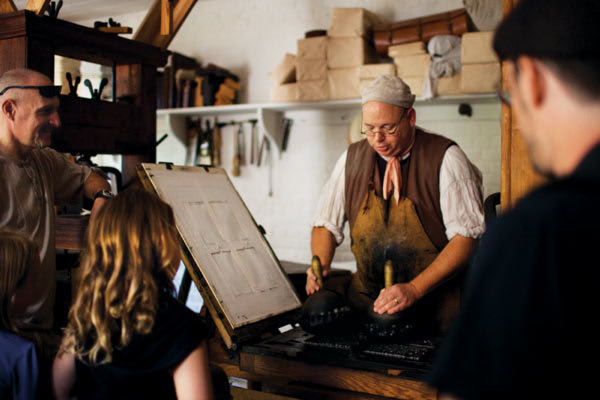
Each letter had to be set individually
on the printing press.


Click image to enlarge |
 
Abigail Schumann interprets the character
of Clementina Rind, editor of the Virginia Gazette from 1773
– following the death of her husband – until her
own death in 1774. |

Click image to enlarge |
Listen to a Behind the Scenes Interview: Alexander Purdie. Dennis Watson speculates on the loyalties of the publisher of The Virginia Gazette in the years leading up to the Revolution.
(MP3, 2.7Mb)
View transcript
This interview is part of an ongoing series of podcasts available on the Colonial Williamsburg site.Learn more.
|
Listen to a Behind the Scenes Interview: Printer. Don’t tell journeyman printer Pete Stinely his work is tedious; he’s been at it for 24 years!
(MP3, 3.4Mb)
View transcript
|
|
Press powerful in colonial times, too!
Thomas Jefferson's "Ideas on American Freedom" was first
printed on Clementina Rind's hand-pulled press.
It was a document Jefferson had drafted at Monticello for the guidance
of Virginia's delegates to the Continental Congress. The colony's
House of Burgesses considered the composition too radical for official
endorsement, but a group of Jefferson's friends persuaded the Widow
Rind to issue it as a pamphlet. Thus A Summary View of the Rights
of British America appeared in August 1774. The future author
of the Declaration of Independence later wrote:
"If it had any merit, it was that of first taking our true
ground, and that which was afterwards assumed and maintained."
It was just one Revolutionary demonstration of the printer's power
to spread incendiary views. But it still may be the most historically
important job to come off a Williamsburg press since William Parks
set up the first one in 1730.
Parks started Virginia's first newspaper
Parks came from Maryland to do government printing and commercial
work. Six years later, he started Virginia's first newspaper. With
the advice and investment of Philadelphia's Benjamin Franklin, Parks
opened Virginia's first paper mill in 1743. Four years later, he
became the first printer in the 140-year-old colony to publish a
volume on its beginnings – The History of the First Discovery
and Settlement of Virginia by William Stith. Success in the
printing business required diversification.
Print shop served multiple purposes
Parks' double-bay-windowed shop served as a stationer's, a post
office, an advertising agency, an office supply shop, a newsstand,
and a bookbindery. He sold magazines and books, maps and almanacs,and
even sealing wax! His press printed broadsides and business forms,
laws and proclamations, tracts and blank record books. In the 20th
century, while excavating the site of Parks' shop, archaeologists
found lead border ornaments used for French and Indian War currency
.
Archaeologists also uncovered hundreds of bits of metal type, apparently
of Dutch origin. Colonial printers imported cases of type from European
foundries, but molding casting replacement letters on site from
lead and antimony took no extraordinary skill.
Hours of labor required to produce Virginia Gazette
Parks' Virginia Gazette, published weekly from 1736 to
1750, was perhaps his most durable achievement, and among the most
labor intensive. Setting type for one page of the weekly newspaper
required 25 hours of hand labor.
"The Hands employed by the Printer are the Compositor and
Pressman, which are two distinct Branches, the one knowing little
of the other's Business," wrote a Parks contemporary. "The
Compositor is he who arranges the Letters and makes up the Forms;
the Pressman only works at the Press, takes off the Impression,
and requires no other Qualification than Strength and a little Practice."
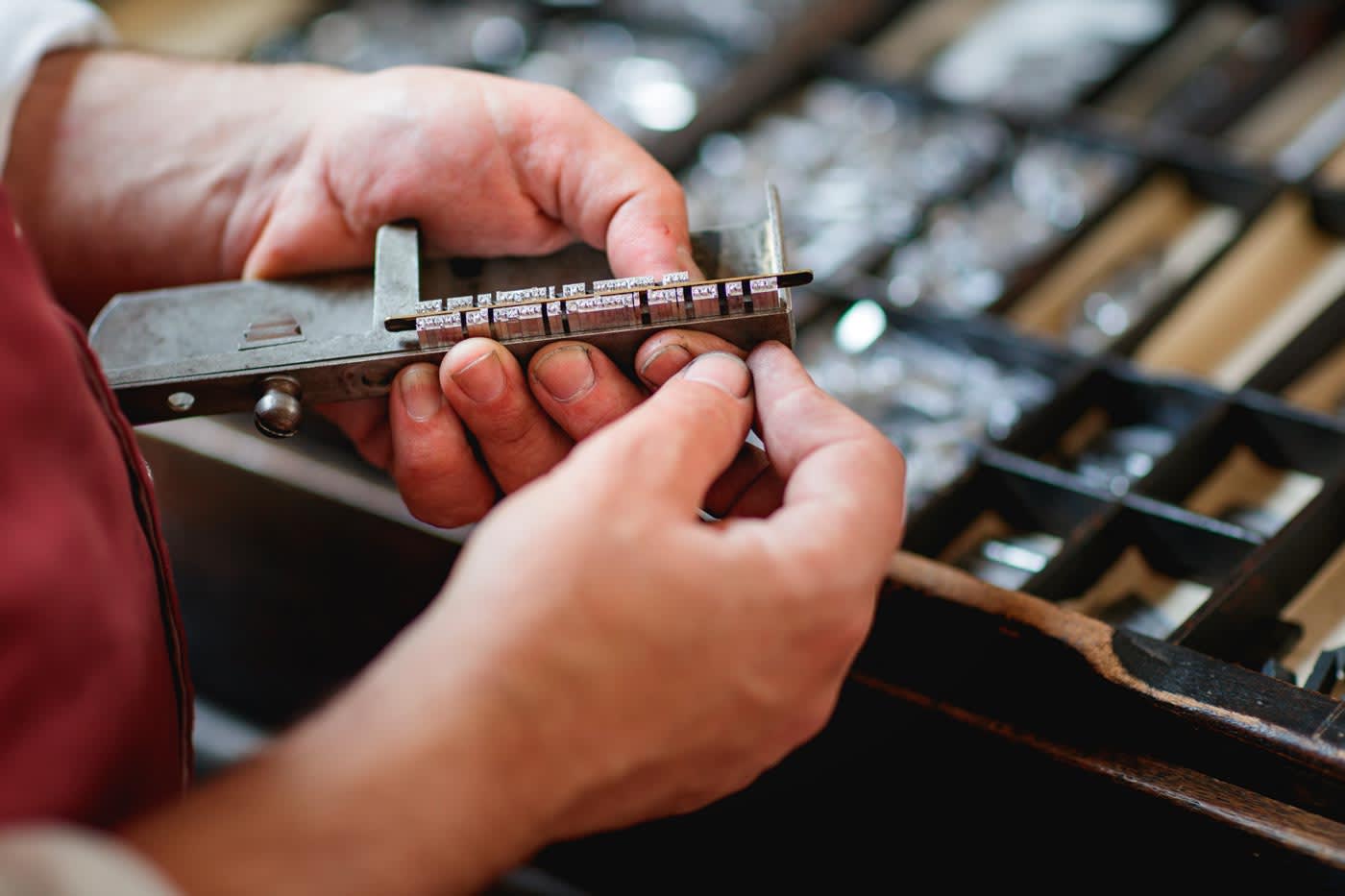
A compositor gathered type, sorted by letter, size, and kind, from
a compartmented box. He set each letter on an iron rule, called
a "composing stick," to form words and lines. The type
had to be set "backwards," as printing reversed the images.
When several lines were done, the compositor set them in wooden
cases called galleys. Sometimes woodcuts were added to illustrate
notices and advertisements. The galleys were tied with string, gathered
and locked in a page-size iron frame, or "chase," and
secured to the stone bed of the press. A carriage carried the chase
back and forth beneath a pressure plate, or "platen."
A fellow called a "beater" used two wood-handled, wool-stuffed,
leather-covered ink balls to spread a mixture of varnish and lampblack
evenly on the type. Moistened sheets of paper were laid in a cushioned
frame that hinged down on the chase, and the carriage was run in.
Mounted on a screw about the size of a man's forearm and operated
by a long-handled lever, the platen was lowered by the pressman,
or puller.
Each sheet was squeezed against the type under about 200 pounds
of pressure to receive its impression, then set aside to dry before
the other side was printed. Each impression required about 15 seconds.
The workday lasted up to 14 hours.
 
Master Printer
Willie Parker
checks a page fresh from the
18th-century printing press. |

Click image to enlarge |
Williamsburg residents supported production of the
newspaper
A community of about 2,000, Williamsburg had plenty of readers
to keep the press going. Parks' newspaper was succeeded by another
Virginia Gazette, and by the time of the Revolution three
newspapers competed under the same name. A Virginia Gazette
still serves the city of Williamsburg today.
Books required more labor and time to produce
Books were more time-consuming and complicated to produce. They
were printed in signatures of four, eight, 12, or 16 pages –
two or more pages on each side of a sheet that, when folded and
cut, presented the text in the proper order for binding.
A bookbinder compiled the signatures and beat them with a heavy
hammer to make the sheets lie close. He arranged them on a sewing
frame and stitched them together at the back fold with linen thread.
As he sewed, he looped the strands around thick hemp cross threads,
which created characteristic horizontal ridges across the spine
and unified the assembly.


Bookbinder Bruce Plumley uses colonial
techniques to bind a book.


Click image to enlarge |
Book covers involved many steps and specialized craftsmanship
Dyed leather was drawn onto boards and glued to heavier endpaper
to cover the volume. Sometimes the endpapers were marbled. All of
the marbled paper used in Williamsburg seems to have been imported
from England, where such work was a craft in itself.
Marbling required a small tank and a mixture of water and a syrupy
gum. The marbler dripped vivid watercolors onto the surface and
drew special combs across it to create distinctive swirls and eddies.
An endpaper was laid on the surface to take up the watercolor, then
removed and dried.
The covers of better books were made of fine leather that was tooled,
stamped, and decorated with designs sometimes rendered in gold leaf.
In Colonial Williamsburg today, the Printing Office, Post Office,
and Bookbindery are located in one shop where press trades are interpreted
and authentic reproduction items from Parks' reconstructed shop
are offered for sale.
For further reading:

|