Experience the Life
: Trades
: Weaver


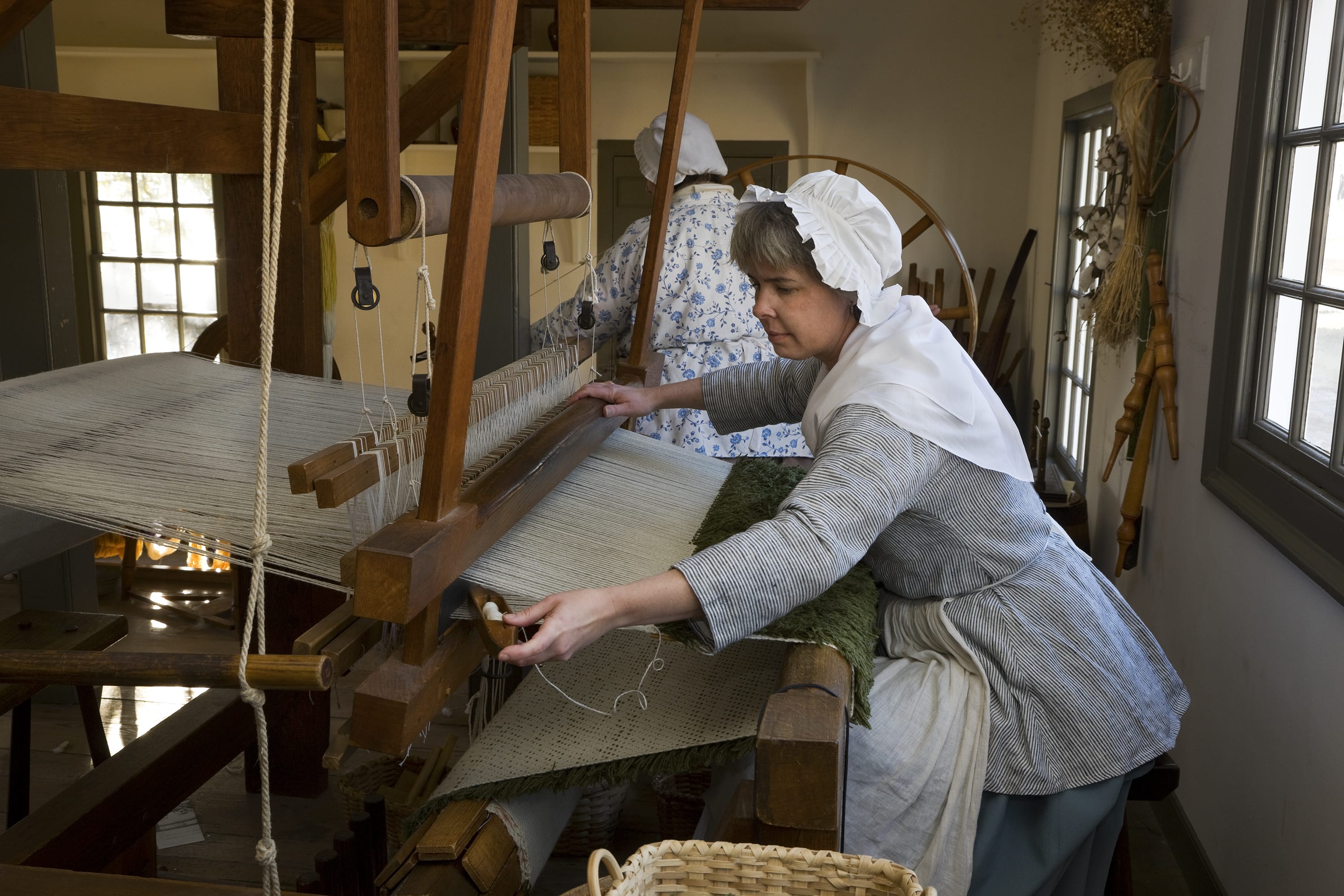
The cantilever loom, operated by Max Hamrick, Jr., was developed in 11th-century Spain.


Click image to enlarge |
- Few weavers in 18th-century Williamsburg
- Cloth came from England, China, India
- Textiles produced in Britain most common
- More economical to purchase fabric from abroad
One of the earliest trades in the Historic Area
America's dependence on imported textiles and other manufactured
goods began the day the English set foot on North America. When
trade with England was restricted during the Revolution, Virginians
turned to newly-established local cloth producers for their textile
needs.
Work on Williamsburg’s cloth manufactory started in
1776. The factory was built on the banks of Queens Creek in York
County, just a stone’s throw from Williamsburg city limits.
Local newspaper advertisements indicate that linen and hempen cloth
were being produced there by 1777. Interpretation of the weaving
trade in Colonial Williamsburg’s Historic Area dates to the
1930s.
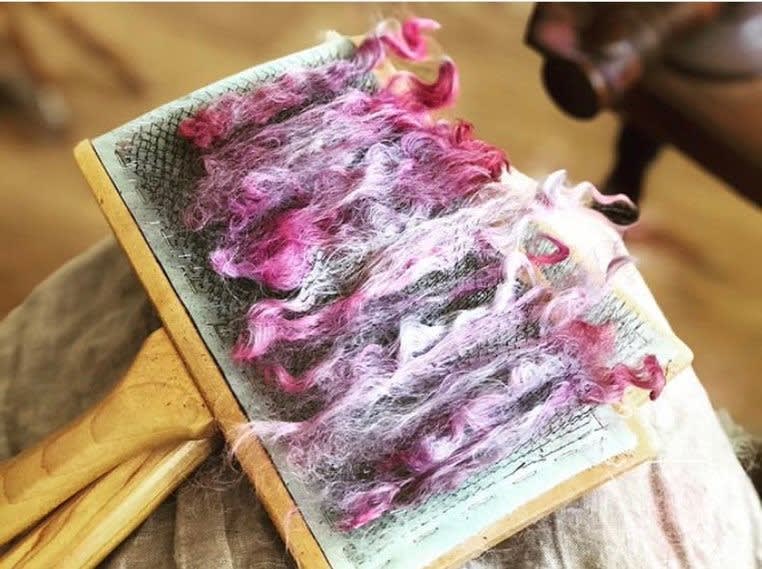
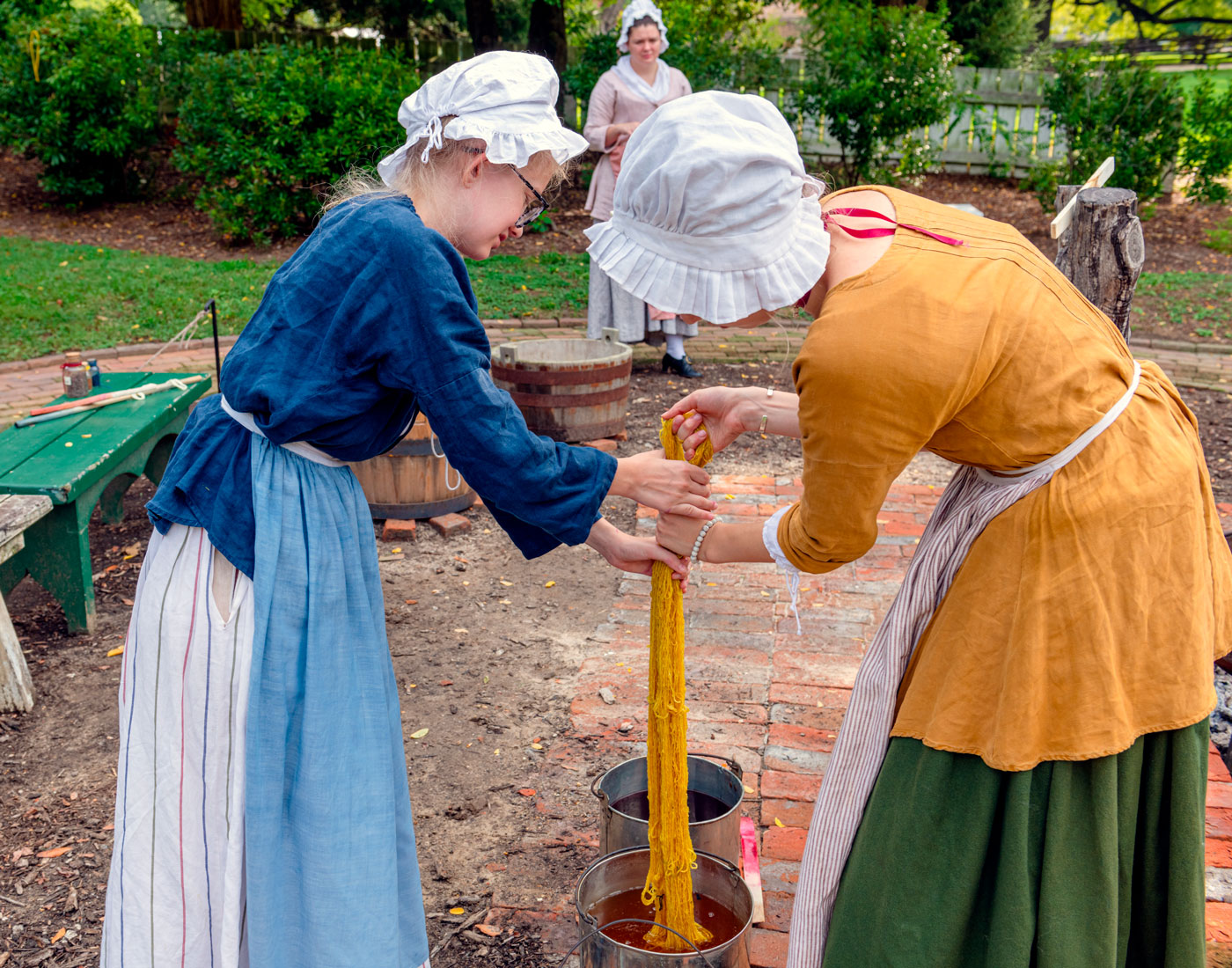
Colors made from natural sources
Nature provided the colors used in dyeing textiles in the 18th century. Today, Colonial Williamsburg’s weavers use the same 18th-century recipes for dyes – all safe enough to drink. An insect called the cochineal from South America makes the color red. 70,000 cochineal are needed to make a pound of red dye that can turn everything from leather to makeup and frosting red – including paint and textiles. Brown comes from walnuts, blue from indigo from South Carolina, Spain, or South America. Purple comes from the Spanish log wood tree, and turmeric from India gives yellow its hue. Orange comes from the root of the madder plant.
Wool is the easiest fabric to dye; cotton is more difficult, and linen is the most difficult of all – the dye tends to sit on the linen, in a sense, not in it. Dyeing was often done on plantations, using different colors of clothing to identify slaves from the same plantation – colorful and expressive folk art came from this practice as slaves used the rich colors to express individuality.


A copy of a bed rug found in Virginia’s Wythe County is a work in progress on the weaver’s loom.


Click image to enlarge |
Cloth in Historic Area today made by the weaver
Today the weavers in the Historic Area interpret the trade to show visitors how weaving might have been done in a small English production weaving house or a large plantation weaving operation. They make textiles needed here that cannot be obtained anywhere else. The giant linen sails of the windmill were made by the weaver, as was the dimity bed furniture used on the bed in the Peyton Randolph House. The Colonial Williamsburg collection contains many original 18th- and 19th-century textiles, all kept in a controlled environment to preserve them for generations, but the weavers copy those items for use or display in the Historic Area. They also examine 18th-century patterns and notes from weavers notebooks to create authentic reproductions. The weavers work with wool, flax, hemp, and sometimes silk and also copy original cloth they find in other museums.
One of the looms weaver Max Hamrick uses was made by the cabinet shop in Colonial Williamsburg’s Historic Area. Crafted of oak and pine, the design of the cantilever loom with a four-shaft counterbalance pattern device dates to the late 11th century in England. The weaver also has a four-post English box loom with an eight-shaft counterbalance mechanism, which has 22 to 24 openings and allows more patterns than the other loom.
The work of Colonial Williamsburg's tradesmen sometimes finds its way into important places. In the early 1990s, Colonial Williamsburg’s weavers made a coverlet which was presented to President George H.W. Bush as a gift from the Commonwealth of Virginia.
Spinning not common in 18th-century Williamsburg
Spinning was a domestic chore not likely practiced much in colonial America, as it was very time-consuming. It would take 12 spinners of wool to keep the weaver busy at the loom, and 100 spinners of cotton to keep him busy. The technology of the spinning wheel dates to 500 B.C. in India, and today Colonial Williamsburg weavers use two spinning wheels to interpret the art of spinning for visitors to the Historic Area.
Listen to a Behind the Scenes Interview:
The Art of Weaving. Max Hamrick is still learning after 40 years of weaving cloth just as it was done in the 18th century
(MP3, 3.1Mb) || View transcript
This interview is part of an ongoing series of podcasts available on the Colonial Williamsburg site.
Learn more. |
For further reading:

|