Page content
View related multimedia and links
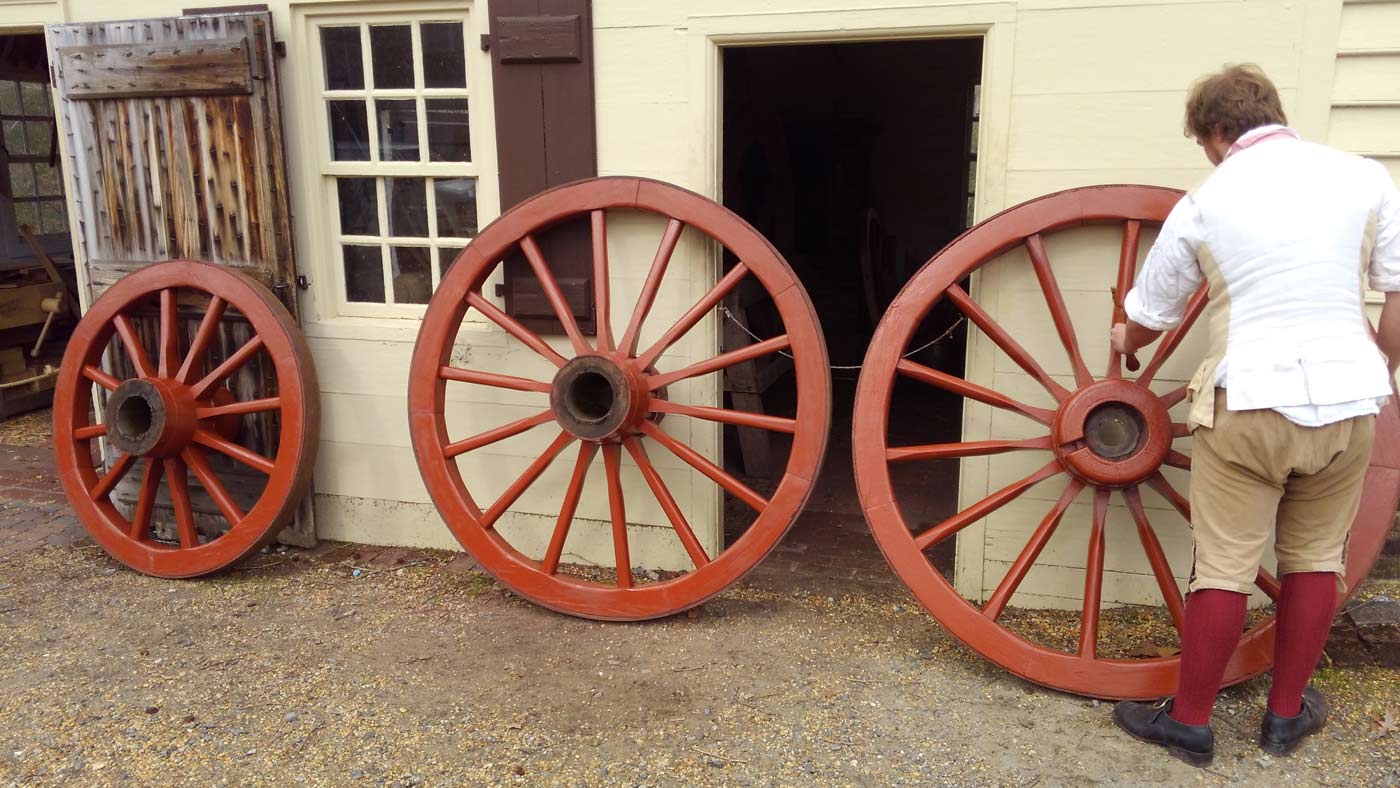
Wheelwrights inspect the wheels on an 18th-century carriage near the Governor's Palace in Colonial Williamsburg.
Wheelwright
Wheels must be round above all else
Made of wood and bound with iron, the wheels of the carriages, wagons, and riding chairs that navigated rugged colonial roads had to be strong and tight. But first and foremost, the wheels had to be round.
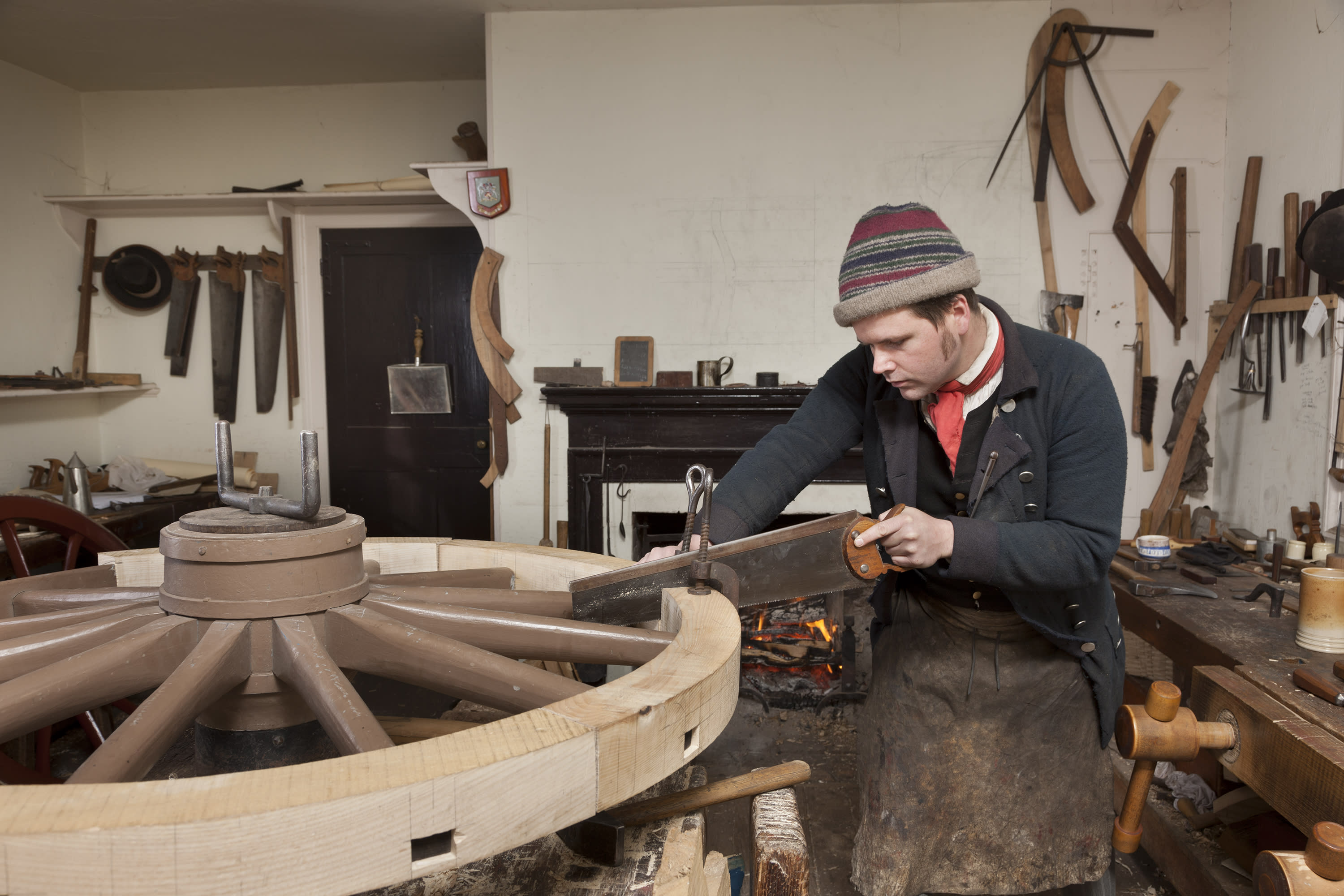
Tradesmen in the wheelwright shop use colonial techniques to create the wheels used on carriages in Colonial Williamsburg today.
Trade requires strength and precision
Producing wheels requires strength, ingenuity, and the talents of both a carpenter and a blacksmith. Precise measuring skills are mandatory.
Like their Williamsburg predecessors, the wheelwrights who practice the trade at the Governor's Palace today start with a hub fashioned on a lathe from properly aged wood such as elm. A tapered reamer opens the center to receive a metal bearing; The wheelwright uses a chisel to create rectangular spoke holes around the circumference of the wheel. Carved from woods like ash, the spokes radiate to meet a rim of mortised wooden arches, called "fellies," that join to form a perfect circle.
Colonial tire made of iron
The blacksmith supplies a big hoop of iron precisely matched to the distance around the fellies. The wheelwright heats the iron tire, which expands just enough to be coaxed on with a heavy hammer. He then douses the wheel with water, which causes the iron tire to shrink a bit, which in turn binds the assembly.
Multimedia and related links
-
Podcasts
- View descriptions
-
Carriages, Carts and Wagons
Conjuring a wheel from elm and iron is one big geometry problem for John Boag, Colonial Williamsburg wheelwright. September 3, 2007
Audio podcast: Listen (mp3) | Transcript
Image enhanced: View (m4a) | Transcript
-
Colonial Weapons System
As important as the cannon is the vehicle to carry it: a two-wheeled cart that transports, supports, and stores the weapon and its accoutrements. Wheelwright John Boag has the task of construction. December 15, 2008
Audio podcast: Listen (mp3) | Transcript
Image enhanced: View (m4a) | Transcript
-
Zooarchaeology
Zooarchaeologist Joanne Bowen decodes 400-year-old leftovers. June 8, 2009
Audio podcast: Listen (mp3) | Transcript
Image enhanced: View (m4a) | Transcript
Video podcast: Watch (mov) | Transcript
-
Colonial Children's Dance
Youth interpreters in Colonial Williamsburg's Historic Area enliven parlors and stages with dancing demonstrations. Kelly McEvoy details the colonial pastime. August 27, 2007
Audio podcast: Listen (mp3) | Transcript
Image enhanced: View (m4a) | Transcript
-
Jamestown Unearthed, Part Two
With 60 percent of James Fort unexplored, the island outpost guards a wealth of stories. Bill Kelso continues the hunt for discovery. October 8, 2007
Audio podcast: Listen (mp3) | Transcript
Image enhanced: View (m4a) | Transcript
-
The Wren Building
Williamsburg's restoration got underway in earnest with the College of William and Mary's Wren Building, explains Louise Kale, director of the Historic Campus. October 20, 2008
Audio podcast: Listen (mp3) | Transcript
Image enhanced: View (m4a) | Transcript
- more...
- Quicktime 7 (free) is required to view the enhanced and video podcasts.
- Subscribe to our podcast RSS feeds:
Audio | Image enhanced | Video
-
Journal articles
-
Wheels and Riding Carts
The Wheelwright Trade
-
President's Message
A Remarkable Experience
-
Laundries
Largest Buildings in the Eighteenth Century Backyard
-
"The Greatest Practical Approach to Exactness."
The Problem of Apportionment and Washington's First Veto
- more articles...

Daily jigsaw puzzles