Page content
View related multimedia and linksThomas Jefferson in Williamsburg
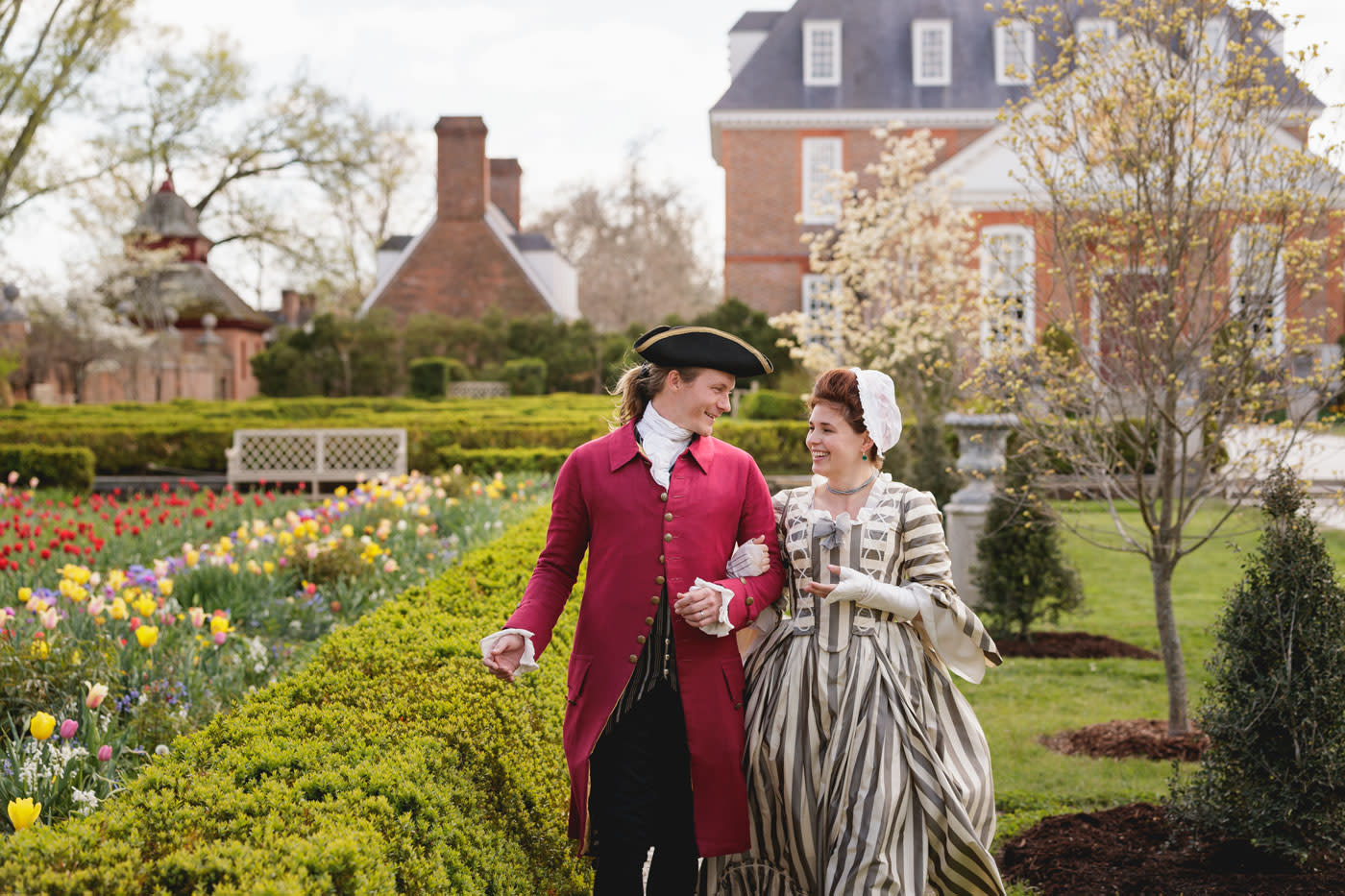
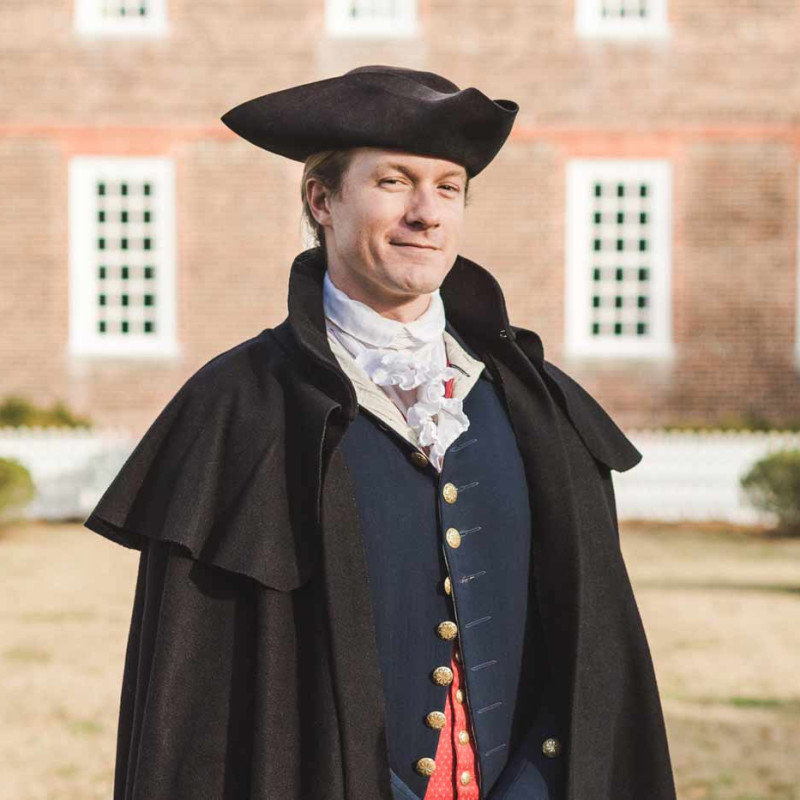
Bill Barker as Thomas Jefferson pauses for a moment of reflection in the Palace Gardens, where Jefferson himself walked more than two hundred years ago.
- Attended the College of William & Mary
- Learned from resident scholars
- Enjoyed music and dance
- Seeds of patriotism planted
- Published his views on rights of British America
- Served as Governor of Virginia
Student at the College of William & Mary
Thomas Jefferson — a serious-minded, freckled-faced boy of 16 from the rolling hills of Albemarle County, Virginia — first came to Williamsburg early in 1760 as a student at the College of William & Mary.
Jefferson plunged into the scholarship that marked his entire life. His principal teacher was William Small, a lively Scottish bachelor competent in everything from rhetoric to mathematics. Later Jefferson read law under the hawk-nosed George Wythe, whose comfortable brick home on Palace Green was often a haven for the young scholar.
Social life included scholarship
A favorite rendezvous for Jefferson, Wythe, and Small was the Governor's Palace. Governor Francis Fauquier was an economist and philosopher who regularly hosted dinners of oysters, wild duck, and Virginia ham, and the conversation might touch on anything from the value of western lands to the latest telescope or water prism sent from London for use in Small's classroom at the Wren Building.
Passion for music nurtured in Williamsburg
Jefferson participated in an amateur music circle at the Palace, too. Music was his "favorite passion," and he practiced his violin regularly every day. He frequently purchased the most recent scores of Corelli or Scarlatti from the Printing Office.
Close friends of Jefferson, Anne and Betsey Blair, frequently hosted groups at their house on Duke of Gloucester Street, where singing would last well into dusk on spring evenings. In 1763, Jefferson fell for 16-year-old Rebecca Burwell, whom he escorted to lively dances in the Apollo Room at the Raleigh Tavern. She later rejected Jefferson's halting proposal.
Seeds of freedom planted at the Capitol
Evidence of Jefferson’s maturing ideas of freedom and self-government surfaced at the Capitol. As a law student, he stood enraptured at the doorway of the House of Burgesses, listening to Patrick Henry speak out against the Stamp Act. As a burgess, Jefferson continued to promote the idea of revolution. As a lawyer, he practiced at the General Court. In 1770, he defended a slave. Despite owning slaves all his life, he spoke then against slavery, saying under the law of nature, “we are all born free.”
Wrote Summary View of the Rights of British America

Jefferson spent many an hour playing the violin, and Colonial Williamsburg's Bill Barker enjoys some practice time himself.
In 1774, Jefferson set his pen to the first of many important documents he would write. From Monticello, he sent Patrick Henry and Peyton Randolph a copy of his proposed instructions for the Virginia delegates who were soon to ride to Philadelphia for the First Continental Congress. The document was published in Williamsburg by Clementina Rind, Virginia's only woman printer, under the title Summary View of the Rights of British America.
Peyton Randolph read the Summary View to a galaxy of Virginia patriots gathered in his home on Market Square. The document was too radical for some, but it moved all. Jefferson's pamphlet was reprinted in Philadelphia and in London and played a part in shaping the course of American self-rule. John Adams of Massachusetts said the Summary View gave Jefferson "the reputation of masterly pen" among Congressional delegates in 1776 and won for the Virginian the assignment of drafting the Declaration of Independence.
Served as Governor of Virginia
In 1779, when he was Virginia's governor, Jefferson introduced a clarion call for freedom of worship in the form of the Bill for Establishing Religious Freedom. The bill did not become law until 1786.
Jefferson's last association with Williamsburg was as governor in 1779 and 1780. These drab years saw Virginia's forces in the field hard pressed. As a resident of the Governor's Palace, Jefferson drew up several plans to modernize the structure. During this time, he must often have contrasted its wartime appearance and atmosphere with his memories of the days of Governor Fauquier. In April 1780, Jefferson moved with the government to Richmond, and Williamsburg stepped backstage in history.
Fond memories of Williamsburg
For Jefferson, however, the memory of Williamsburg was forever green. In his student days he sometimes in exasperation called the city "Devilsburg," and later described some of its public buildings as "rude misshapen piles." Yet his final judgment, which he passed along to a favorite grandson, was that Williamsburg had offered "the finest school of manners and morals that ever existed in America."
For further reading:
- Governor's Palace
- Raleigh Tavern
- Capitol
- Patrick Henry
- Declaration and Resolves of the First Continental Congress
- Virginia Stamp Act Resolutions
- Introduction to Colonial African American Life
- College of William & Mary website
Multimedia and related links
-
Podcasts
- View descriptions
-
Thomas Jefferson on Religion
Thomas Jefferson's policy on religioius freedom rests on one ageless axiom: do unto others. Interpreter Bill Barker expounds. April 27, 2009
Audio podcast: Listen (mp3) | Transcript
Image enhanced: View (m4a) | Transcript
-
We hold these truths
Hear the words that started a war, read by Thomas Jefferson interpreter Bill Barker. Episode one of July's Revolutionary Documents series. June 30, 2008
Audio podcast: Listen (mp3) | Transcript
Image enhanced: View (m4a) | Transcript
-
The Jefferson Blog
A new blog subjects Thomas Jefferson's ideals to modern scrutiny. Add your two cents beginning this July. June 23, 2008
Audio podcast: Listen (mp3) | Transcript
Image enhanced: View (m4a) | Transcript
-
The Declaration of Independence
Hear the words that were catalyst to the Revolution, read by Bill Barker, Colonial Williamsburg's Thomas Jefferson. July 2, 2007
Audio podcast: Listen (mp3) | Transcript
Image enhanced: View (m4a) | Transcript
-
Thomas Jefferson vs. Patrick Henry
Bill Barker as Thomas Jefferson and Richard Schumann as Patrick Henry continue their debate on the role of religion in government. July 24, 2006
Audio podcast: Listen (mp3) | Transcript
Image enhanced: View (m4a) | Transcript
-
Thomas Jefferson on Religion
Thomas Jefferson speaks of his statute of Virginia for religious freedom, as delivered here by Bill Barker. July 17, 2006
Audio podcast: Listen (mp3) | Transcript
Image enhanced: View (m4a) | Transcript
- more...
- Quicktime 7 (free) is required to view the enhanced and video podcasts.
- Subscribe to our podcast RSS feeds:
Audio | Image enhanced | Video
-
Journal articles
-
Captain Jack Jouett's Ride to the Rescue
Did Virginia's Paul Revere Spare Thomas Jefferson the Acquaintance of a British Hangman?
-
Presidential Portraits
"Stuart is all the rage, he is almost worked to death...."
-
Northwest Passage
-
Thomas Jefferson, Son of Virginia
- more articles...

Daily jigsaw puzzles