|
Meet the People
: George Washington
: George Washington in Williamsburg
 |
| George Washington |
In Williamsburg, seat of Virginia's government, George Washington
- Secured his first military commission
- Learned the art and mystery of politics
- Became leader of a continental revolution
Early visit
The tall figure of George Washington on horseback, his large, strong hands
on the reins, was well known in Williamsburg for three decades. Washington may
have known Williamsburg as early as 1749 when, as a 17-year-old, he may have
visited his colony's capital to apply for a surveyor's license from the College
of William & Mary.
More than 30 years later – in the autumn of 1781 – he again rode
into town, this time as commander in chief of the American army.
Political and social life
In 1759, 27-year-old George Washington took a seat in the House of Burgesses
in the Capitol and helped shape the idea of self-government for the next 16
years. He dined with such locals as George Wythe and Peyton Randolph. He worshipped
at Bruton Parish Church. He enjoyed congenial evenings at the Raleigh, King's
Arms, and Christiana Campbell's taverns. He attended the theater and once viewed
four performances in a row, to see a particular red-haired actress deliver her
lines. He supped with the governor and attended balls at the Palace and the
Capitol. He patronized Williamsburg's tradesmen.
Family life
After his marriage to the widow Martha Dandridge Custis, Washington spent his
honeymoon in Williamsburg. He sometimes brought his two beloved stepchildren
with him to town. Washington administered the Custis estate in and around Williamsburg
until Martha's son, John Parke Custis, came of age. The Custis estate included
a large brick house on a square near the Public Hospital, three lots and houses
on Duke of Gloucester Street opposite Bruton Parish Church, and a plantation
in York County on Queen's Street.
Washington’s home at Mount Vernon was 160 miles, or four day's journey,
from the capital, so Washington rented out most of the Williamsburg property
during his trusteeship.
Early military life
For Washington the military officer, Williamsburg was headquarters. In January
1754, he made his way back to the capital from a hazardous trip deep into the
Ohio country, where in vain he had warned French troops and trappers off British
soil. Later, he returned as a survivor of the carnage at Braddock's defeat.
Gaining political influence
For Washington the legislator, Williamsburg was a proving ground. He was an
intimate of every political leader of the colony during his years as a Virginia
legislator. He introduced the Nonimportation Agreement in 1769 and in 1774 was
sent by his fellow lawmakers as one of Virginia's seven delegates to the first
Continental Congress.
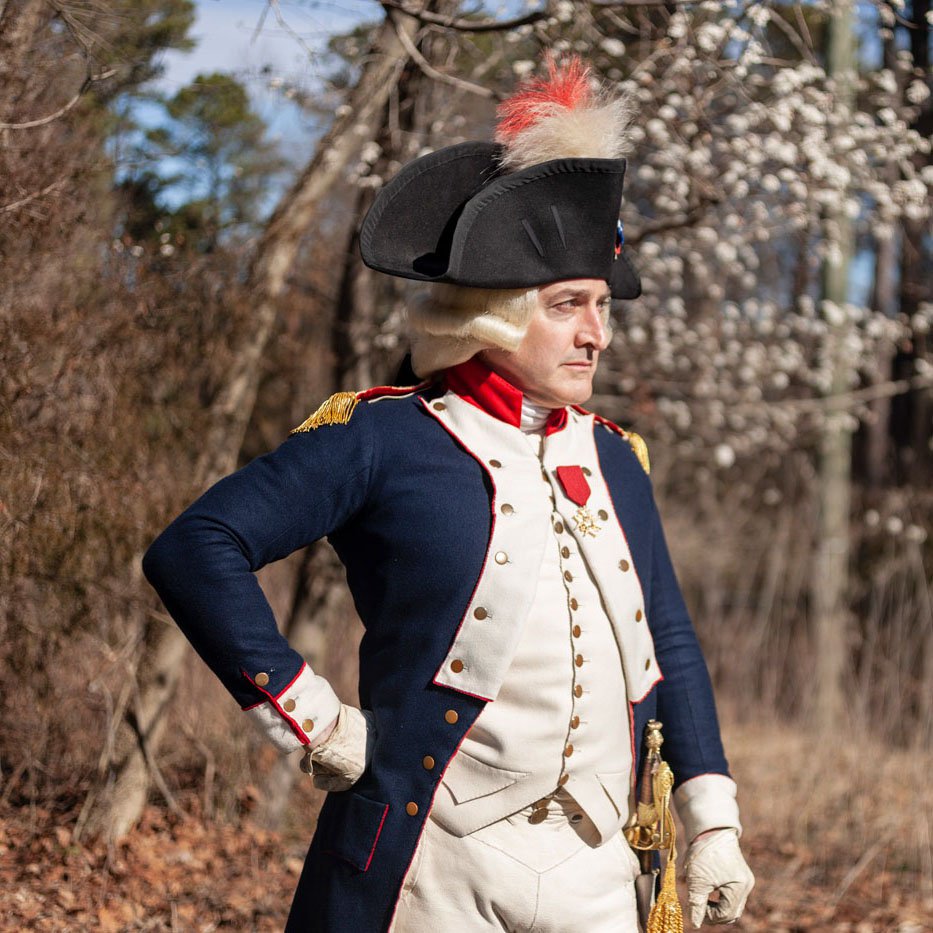
General Washington
For Washington the general, Williamsburg was a staging point before victory
at Yorktown. From his headquarters at the George Wythe House, he dispatched
pleas for reinforcements, blankets, bread, clothing, ammunition, horses, and
rum. September 27, 1781, Washington issued the general orders for the advance
on British General Cornwallis at Yorktown. Within three weeks, the British surrendered
their positions and their arms to American and French forces.
For further reading, see the biography of George Washington or excerpts from
Duel in the Wilderness, written by Karin Clafford Farley (a children's
book based on George Washington's own diary, published by The Colonial Williamsburg
Foundation, Williamsburg, Virginia).

For further reading:

|  |