Page content
View related multimedia and linksPalace Green
- Nicholson plan called for space that reinforced power of colony's capital
- Palace Green focuses eye and mind to source of executive authority
- Green provided residents of official residence with view to the heart of community
- Governor's Palace shared green with modest homes and businesses
- Governor Gooch planted two rows of catalpa trees down the length of green
- Community celebrations in honor of treaties and visiting dignitaries held here
- Source of city pride among first places to be restored
Palace Green an important part of original Williamsburg city plan
When Governor Francis Nicholson drew the plan of Williamsburg in 1699, he arranged its streets and spaces with attention to the relationships of purpose and power in the colony's new capital. Thus the city's main north-south axis commands twice the breadth of its central east-west thoroughfare and rolls imperiously 900 feet to the gates of the Governor's Palace.
Focus of Executive Authority
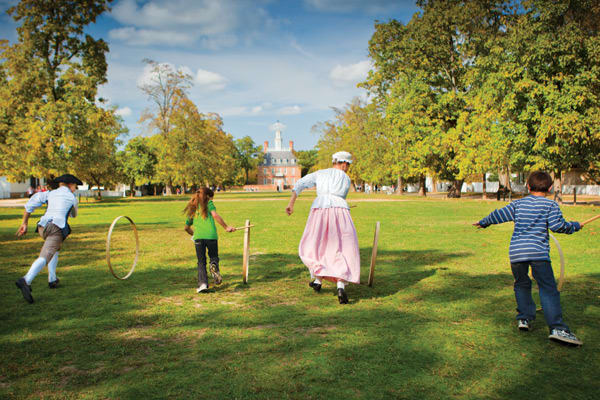
Palace green was intended to focus the eye as well as the mind on the source of executive authority in Virginia and to provide the stately official residence at its head with an unimpeded vista to the heart of the community and beyond. In its progress from the College of William and Mary, Duke of Gloucester Street slips past the foot of the green at Bruton Parish Church and moves on to the Capitol.
At first the governor's residence shared Palace green with modest homes like the Brush-Everard House, with craftsmen's shops, with a tavern, and with America's first theater. Governor William Gooch improved appearances in 1737 by planting two rows of catalpa trees 100 feet apart down the length of the green.
Fine homes built on green in 18th century
After the middle of the 18th century, Palace green was further enhanced by the erection of such fine homes as Robert Carter's rambling residence and the George Wythe House. Still, piles of coal and slag stood in the foundry yard at the James Geddy House on the corner, lead was smelted beyond Mr. Wythe's house, and harnesses were made behind Elkanah Deane's home.
Community celebrations held on Palace green
Palace green was a likely location for celebrations like the one attending the renewal of a treaty of friendship with the Indians in 1752. The Virginia Gazette reported that after the "emperor and the Empress of the Cherokee Nation, with their son the young Prince" arrived, "several beautiful Fireworks were exhibited in Palace Street."
Restored green stands as originally intended
Always a source of city pride, the green nevertheless suffered some encroachment in the 19th century. Two schools rose on the grounds of the vanished Palace and a Victorian home cut off the vista at the southern end. Restoration of the area was among the first of Colonial Williamsburg's goals, and Palace green stands today as it was described in the 18th century – "a big lawn that forms a pretty avenue."
Multimedia and related links
-
Podcasts
- View descriptions
-
Curator of Historic Interiors
Curator Emily Roberts enjoys setting a proper Christmas supper for 10 in the Palace. December 19, 2005
Audio podcast: Listen (mp3) | Transcript
Image enhanced: View (m4a) | Transcript
-
The Governor's Palace at 75
Fresh eyes refocus an architectural icon. Chief Curator Emeritus Graham Hood on recomposing an 18th-century landmark. March 30, 2009
Audio podcast: Listen (mp3) | Transcript
Image enhanced: View (m4a) | Transcript
-
Southern Hospitality
A gracious host, the Governor's Palace met the needs of nine governors and the Continental Army. Tom Spear details the venerable building's past. August 13, 2007
Audio podcast: Listen (mp3) | Transcript
Image enhanced: View (m4a) | Transcript
-
A new look at the Governor's Palace
Curator Erik Goldstein researched for three years for the reinstallation and reinterpretation of the arms display at the Governor's Palace. April 3, 2006
Audio podcast: Listen (mp3) | Transcript
Image enhanced: View (m4a) | Transcript
-
A Slave's Perspective
The Declaration of Independence was a promise extended to white men only. Hope Smith portrays Eve, a slave in the Peyton Randolph house. July 16, 2007
Audio podcast: Listen (mp3) | Transcript
Image enhanced: View (m4a) | Transcript
-
The Slave Trade
The slave trade touched the lives of people around the globe, explains Colonial Williamsburg's Educational Program Development director Bill White. February 9, 2007
Audio podcast: Listen (mp3) | Transcript
Image enhanced: View (m4a) | Transcript
- more...
- Quicktime 7 (free) is required to view the enhanced and video podcasts.
- Subscribe to our podcast RSS feeds:
Audio | Image enhanced | Video
-
Journal articles
-
Palace Days
Recollections of Dismantling the Most Beautiful Rooms in America
-
Fighting... Maybe for Freedom, but probably not
Slaves and free blacks in the Revolutionary War
-
Slave Conspiracies in Colonial Virginia
-
Finding Slaves in Unexpected Places
Keeping Blacks in Bondage Was Not a Southern Monopoly
- more articles...

Daily jigsaw puzzles

