|
 |
CW Journal
: Christmas 04 : Captain John Smith's Christmas


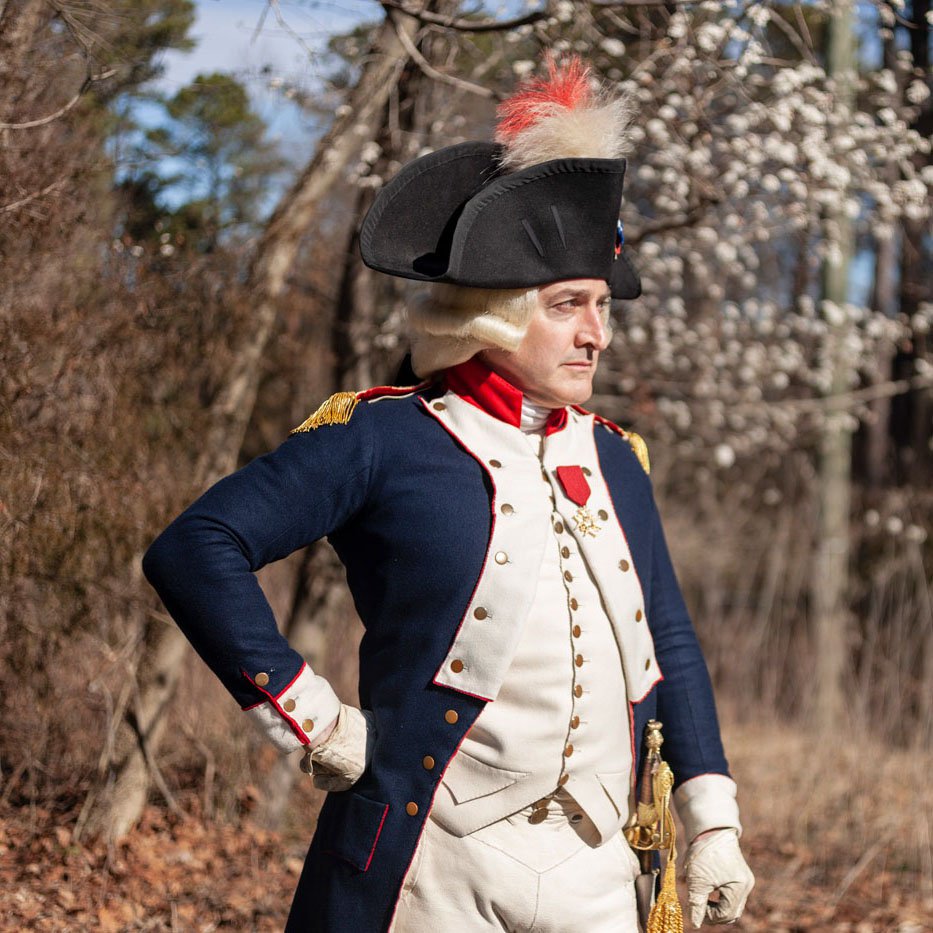
 Smith's "dry smoaky" Christmas. Don Hulick as Smith, left, Anthony Fortune, Christopher Jones, Lindsey Fortune,
Monique Jones, and Carson Hudson.

 Click image to enlarge |
by Dennis Montgomery
The
ever-scribbling Captain John Smith wrote the first report of a Christmas
celebration in English North America. In a sentence often reprinted he detailed
a Yuletide feast of shell food and meat and poultry and other jolly goodies
devoured in the snug huts of a hospitable band of Indians beside the Chesapeake
Bay.
His account occasionally is mistaken
for the relation of the continent's original English Christmas, but Smith's
anecdote is no more than the first description of one in the First Colony.
There is a difference between the first time a thing happened and the first
time that thing was written about. In any case, the captain detailed neither
the first December 25 he passed in the brand-new Old Dominion, nor the first
that Anglo-Saxons abided on these shores, nor the first that Europeans spent in
the Western Hemisphere. Nor was it on what we call Christmas.
Nevertheless, Smith's sentence is
worth reprinting once more. It is part of a narrative that begins at Jamestown
on December 29, 1608—by the Old Style calendar the seventeenth-century English
used. As they often were in winter, the settlement's inmates were famished,
and, not for the first time, Smith was off on the hunt of provender. With a barge,
a boat, and forty-six men, he set down the James River. He planned to round Old
Point Comfort, where Virginia's Lower Peninsula pokes into the bay, make his
way up the York, and land at the north-bank Indian village Werowocomoco to
barter with Powhatan, headman of a loose association of Tidewater tribes, for a
boatload of corn. Powhatan asked to be paid with construction of an
English-style house, a grindstone, fifty metal swords, firearms, a cock, a hen,
and, for good measure, copper and beads.
The captain and his company, who would
have sailed downstream with the outgoing tide, made about twenty-two miles the
first day. They spent the night at Warraskoyack, an aboriginal enclave up Pagan
Creek on the James's south side near modern Smithfield. It sounds as if in the
morning a winter nor'easter—the direction Smith was going—was starting to blow.
But, with twelve of his bunch, he left for Kecoughtan, a village of naturals
about six miles across Hampton Roads, at the confluence of the James and
today's Hampton River. Modern Hampton. Now the ingeminate sentence:
The next night being lodged at
Kecoughtan; six or seaven dayes the extreame winde, rayne, frost and snow
caused us to keep Christmas among the Salvages, where we were never more merry,
nor fed on more plentie of good Oysters, Fish, Flesh, Wild-foule, and good
bread; nor never had better fires in England, then in the dry smoaky houses of
Kecoughtan.
The description originally appeared in
Smith's travel tale The Proceedings of the English Colonie in Virginia since
the first beginning from England in the yeare of our Lord 1606, till this
present 1612, with all their accidents that befell them in their Journies and
Discoveries. That
110-page tome was the third of more than a dozen of Smith's literary endeavors
that fell from the press. Twelve years later, he recycled the passage in his
eighth, the six-part, 248-page The Generall Historie of Virginia,
New-England, and the Summer Isles with the names of the Adventurers, Planters
and Government from their first beginning in 1584 to this present 1624.
Smith's Christmas narrative runs
sixty-one words, but if you've been paying attention, you've noticed there is
more to tell. The Werowocomoco expedition began four days after the anniversary
of the Nativity. Smith spent December 25 at Jamestown. How is it, then, the
captain said he kept Christmas at Kecoughtan? He didn't land there until
December 31.
It is tempting to think that he meant
to say he was celebrating New Year's Eve, but, by the Old Style calendar, New
Year's Eve was March 24. The thing is that in Smith's day, by custom, Christmas
began December 25 and lasted through Twelfth Night, or January 6.
To digress a little more, the New
Style calendar, which we employ, as at the time did continental Europe, ran ten
days in advance of Smith's. So, by our reckoning, his party with the
Kecoughtans began January 10, 1609.
That explained, your attention is
recalled to the title of The Proceedings, which was given entire for a reason. It says the English
embarked for Virginia in 1606. They must, then, have shared at least one
Christmas—1607's—before Smith's food foray in the winter of 1608.
In
fact, they had shared two, the first outbound aboard ship, the second in
Virginia. The settlers took to their vessels December 19, 1606, Old Style, at
Blackwell, near London; fell down the Thames with the midnight tide; and,
waiting for favorable winds, anchored January 1—still 1606 because, remember,
their New Year began March 25—in the Downs. Which is to say that, as colonists,
the Jamestowners spent their first Christmas in England. At all events, Smith
published no account of the offshore festivities, and neither, it seems, did
anyone else.
In April 1607, the 104 or 105
guinea-pig pioneers dispatched for America reached the James. Thirty-eight
lasted the eight months it took to gain their first Christmas on Jamestown
Island. The other sixty-six were well and safely in their graves, felled by
Indians, disease, sloth, starvation, cold, and melancholy.
Smith said that their minister, the
Reverend Mr. Robert Hunt, who didn't die for a month or so more, was
conscientious in his performance of the Church of England's rituals, so it is
doubtful Hunt neglected services on Christ's birthday.
By the way, this was thirteen years
before the settlement of Plymouth, so the Pilgrims are not even in
first-Christmas running. They didn't like the holiday anyway.
Hunt probably offered his hungry
parishioners communion at Jamestown's makeshift church, a structure Smith said
was "a homely thing like a barne, set upon cratchets, covered with rafts,
sedge, and earth." The captain wrote no account of that Yule's celebrations
either; but he was absent, off foraging then, too, on a ramble that appears to
have put him in a tight spot.
About December 10, 1607, Smith took a
handful of men up the James and into the tributary Chickahominy scrounging for
victuals. Within two days, the captain was snared, probably near today's
Bottoms Bridge, by a hunting party which Powhatan's kinsman Opechancanough
commanded. They began a trek north that, by best guess, put the Indians and
their captive captain on the Rappahannock, the river next above the York, on
Christmas Day.
In his description of these reverses,
Smith mentions Christmas not at all, which, under the circumstances, is not
hard to understand. After four or five days of wandering about, Indian village
to Indian village, he and his captors fetched up on Werowocomoco, where
Opechancanough introduced Smith to Powhatan. There, on December 31, it seems,
occurred the episode in which Pocahontas, one of Powhatan's daughters,
dissuaded her father's headsman from dashing out Smith's brains. The next day
Powhatan sent Smith back to Jamestown.

 Reverend Hunt, portrayed by John
Turner, administering Christmas communion to Willie Balderson as one of the
first Jamestown settlers.

 Click image to enlarge |
The
year Smith escaped being brained was not, however, the year of the first English
Christmas in North America. Not by twenty-three. Look again at the title of
Smith's The Generall Historie of Virginia, New-England, and the Summer
Isles. It says the
English colonies had "their first beginning in 1584."
Englishmen and Englishwomen first
passed a New World Yuletide during the sixteenth-century attempt to settle
Roanoke Island. Sir Walter Ralegh, the sponsor, dispatched exploratory voyages
in 1584, and 108 settlers in 1585. Ralegh, by royal patent was
to discover, search, finde out, and
view such remote, heathen and barbarous lands, countreis, and territories, not
actually possessed of any Christian prince, nor inhabited by Christian people,
as to him, his heires and assignes, and to every or any of them shall seeme
good
and to govern all the territory within
200 leagues of the settlement. Roanoke Island is within the Outer Banks of
today's North Carolina. But Ralegh had christened his holdings Virginia, in
honor of his benefactress the virgin, Queen Elizabeth I.
The Roanoke Islanders endured
hardship, adventure, and privation for more than a year before catching a ride
home with the passing Sir Francis Drake, headed back to England fresh from a
raid on the Spanish at Cartageña. During their stay, a party of Roanoke
explorers ventured to the neighborhood of modern Norfolk, seem to have spent
the winter, and may have become the first English to enjoy Christmas in modern
Virginia proper. But not a line about that December 25, in either place, seems
to have survived.
No matter. The first Europeans to pass
a Yuletide anywhere in Virginia were Spanish—a band of Jesuit missionaries
encamped somewhere north of the James, perhaps in the region where Queen's
Creek flows into the York, above modern Yorktown, in September 1570.
Safe to say the Catholic fathers
celebrated mass that Christmas, but Indians killed them in February, and no
description of their December 25 observance has come to light. By 1570,
however, Spaniards and the Christian religion were unremarkable in the New
World, and, anyway, the primary annual Christian celebration was of the
Resurrection, which the Queen's Creek fathers lived not to see.
The
first Spaniards treated to a New World Christmas were the crewmen of Columbus's
fleet, the Niña,
the Pinta, and his
Santa María. About
the Yuletide of 1492 the admiral, as Columbus was styled, wrote in the journal
of the voyage that Christmas was the day his flagship sank.
The Niña and the Santa María—the Pinta had abandoned them—were cruising the
Caribbean off Santo Domingo. According to the journal, at vespers December 6,
by the New Style calendar, they put into a port that the admiral named Puerto
San Nicolas "in honor of St. Nicholas whose day it was."
The eighteenth, off Haiti, Columbus
ordered "the ship and caravel to be adorned with arms and dressed with flags,
in honor of the feast of Santa Maria de la O, or commemoration of the
Annunciation which was that day, and many rounds were fired from the lombards."
Lombards are artillery.
A chieftain of the island came to the Santa
María attended by
counselors, and found Columbus dining under the poop—the aftermost and highest
deck of the ship, which formed the roof of the cabin in the stern. Columbus
shared his meal, and with his guest exchanged gifts. The admiral got a belt
with pieces of gold worked thin. To the chieftain he gave the drapery from his
bed, amber beads from his neck, a pair of colored shoes, and a bottle of
orange-flower water.
On December 23, the admiral, still
coasting off Haiti, sent ships' boats to investigate another reach of the
island. When the boatmen returned, "They held it for certain that, if the
Christmas festival was kept in that port, all of the people of the island would
come, which they calculated to be larger than England."
Drifting in a dead calm on Christmas
Eve from Santo Tomé toward Punta Santa—which seems to be Puerto San Nicolas—the
Santa María's
tiller was entrusted, against standing orders, to an unqualified common sailor.
About midnight, the dolt put the flagship on a sandbar east of Cap Haitien on
the island's north coast.
Columbus and the master of the vessel,
Juan de la Cosa of Santoña, clambered on deck, and put a boat over the side, de
la Cosa in command, with the idea of oaring the ship off. But de la Cosa, who
owned the Santa María, fled
instead for the safety of the Niña—where
he was driven off. In the darkness, Columbus ordered the Santa María dismasted to lighten and refloat her,
but it was no use. "Her side fell over across the sea, but it was nearly calm.
Then the timbers opened and the ship was lost."
The admiral sent two men ashore to ask
the leader of the island's nearest village, Guacanagarí, for assistance with
salvage. Much was rescued, and Columbus took heart at that much good fortune.
Be that as it may, there was too little room aboard the Niña to accommodate the Santa María's complement, and Columbus was forced
to maroon thirty-nine sailors. With a year's provisions and a ship's boat, he
left among them a caulker, a carpenter, a gunner, and a cooper with orders to
build a fortress—the first Spanish outpost in America, and guardian of the
claim of Ferdinand and Isabella to Columbus's discovery.
Yet the Spanish look to have been
about five centuries too tardy to assert clear title to having been the first
Europeans to pass Christmas in the New World.
About
the year 1000, someone whose name is lost to time wrote on vellum The Saga
of Eric the Red. A
Norseman and a Thor worshiper, Mr. Red is credited with sailing from Iceland to
Greenland and establishing a European colony in the Western Hemisphere years
before.
For the purposes of a story about the
first New World Christmas, a pagan's adventures matter not much. But, if the
narrative is to be credited, by the time Eric's tale was written, the Vikings
had introduced Christianity, and by implication Christmas, to North America,
where they had also translated the custom of making merry at the Yule.
Before 1001, according to the tale,
the Christian voyager Thorbiorn set sail from Iceland with a party of thirty,
among them the Christian woman Guidrid. They arrived in Greenland, about
fifteen of them surviving the trip. Eric and his wife, Thiodhild, a woman the
newcomers seem later to have converted, welcomed them. Eric and Thiodhild begat
Leif the Lucky—the Christian also known as Leif Eriksson.
Eric's narrative is quirky, but the
grownup Leif, after a voyage to Norway, Ireland, and Scotland, returned and
"proclaimed Christianity throughout the land, and the Catholic faith." A church
was built, a structure named for Thiodhild, "and there she and those persons
who accepted Christianity, and there were many, were wont to offer their
prayers."
Thor's ways, however, were not
neglected. The saga reports the twelve-day celebration of the Yule in honor of
Odin at the following winter's solstice—Christmas time: "Preparations were made
for the Yule feast, and it was so sumptuous, that it seemed to the people they
had scarcely ever seen so grand an entertainment before."
Just when, the saga doesn't say, but
about 160 of those people sailed south to Newfoundland a year or so later,
where they met Indians with skin-hulled canoes. The next year a party sailed
farther south, perhaps to Nova Scotia. There they ran into more natives—whom
they called Skrellings, which in Viking meant "savages"—spent the winter, and captured
and baptized two Indian boys. Being good Christians, they presumably remembered
Christmas.
The account may not be entirely
reliable. It matter-of-factly records the surprise of a Uniped, a member of a
race of one-legged men, who hopped away into the wilderness. Nevertheless, the
saga, in its account of a Yule bash, comes close to detailing a Christmas
observance. Which brings us back to Captain Smith.
If you are still paying attention,
you've noticed that Smith's Kecoughtan banquet, like Eric the Red's winter
feast in Greenland, lasted twelve days. The first relations of the first New
World Christmases take on a sort of symmetry. The reason for that is no farther
to seek than Michael Olmert's story "Williamsburg's Long Christmas," at http://www.history.org/Foundation/journal/Christmas04/days.cfm

Dennis Montgomery's first journal Christmas story,
"How to Make a Wreath," appeared in the winter 1991-1992 issue. His essay on
Christmas pye appeared in the October/November 1999 magazine.
Suggestions for further reading:

|  |
|