CW Journal
: Summer 2007 : Rare Sheep

 Colonial Williamsburg cooper Marshall Scheetz with Hog Island sheep at Great Hopes Plantation.

 Click image to enlarge | 
 Hog Island sits off Virginia's Eastern Shore, about mid-right in the map.

 Click image to enlarge | 
 Scheetz delivered a 2002 report on their future on the island, now owned by the Nature Conservancy.

 Click image to enlarge | 
 Elaine Shirley manages the Leicesters in Colonial Williamsburg's rare breeds program.

 Click image to enlarge | 
 Robert Bakewell, in a ca. 1788-91 portrait by John Boultbee.

 Click image to enlarge | 
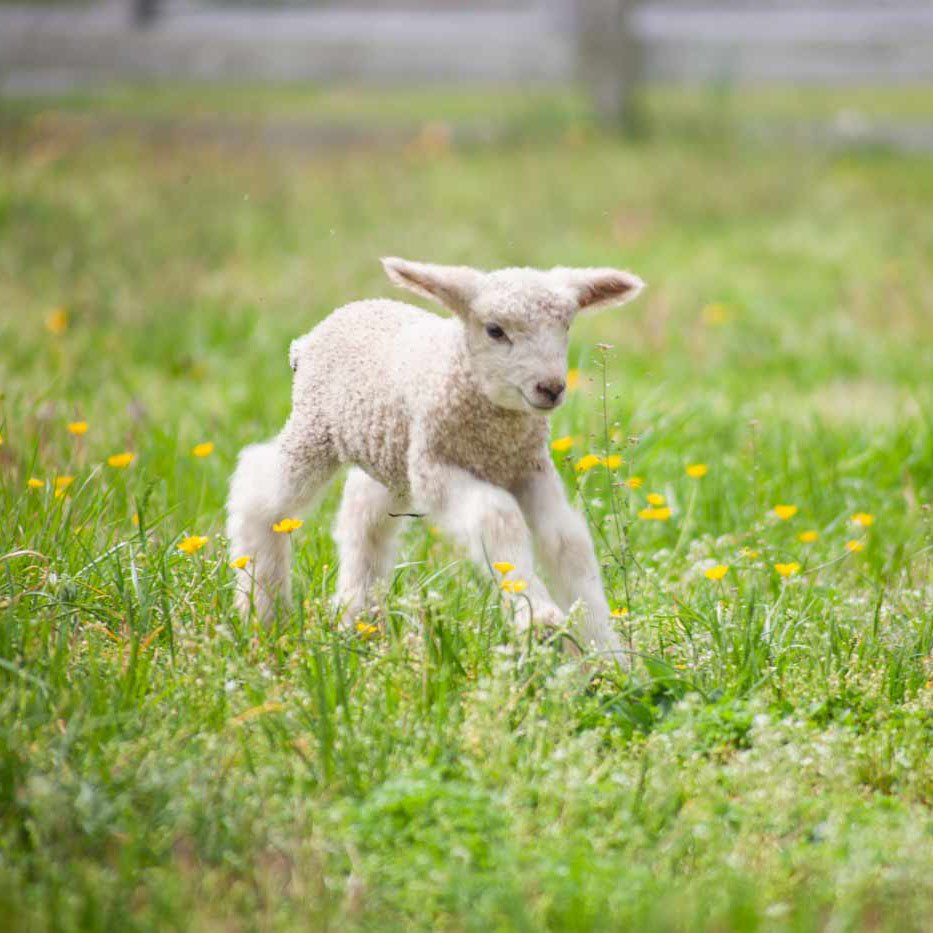
 Leicester Longwool lambs

 Click image to enlarge |
From Hog Island and Leicester
text by Ed Crews
photos by Dave Doody
Colonial Virginians didn't care much
for sheep. For eating, they preferred pork
and beef. For making money, they could do
better with tobacco. Plus, sheep required a lot of attention
and protection from predators.
Virginians kept sheep from their colony's earliest
days and occasionally might enjoy a rack of
lamb, but sheep didn't arouse enthusiasm. That
changed, gradually, as the colony moved away from
tobacco and the Revolution stimulated demand for
homegrown wool and meat. But, for a long time in
early Virginia, sheep, known to science as the creatures
Ovis aries, got little attention. Contemporary
visitors described them as "small and mean," "miserable,"
and "degenerate."
Nobody today applies those terms to the two
rare breeds of sheep Colonial Williamsburg keeps
in its Historic Area. They're Hog Island sheep and
Leicester Longwools, watched closely, well fed, and
cared for. They epitomize two schools of eighteenth-
century animal husbandry.
The Hog Island sheep show what a species
can become
when left alone.
They're descended from
animals raised decades
ago on Hog Island, a
45,000-acre barrier island
off Virginia's Eastern
Shore in the Atlantic
Ocean. The environment
made them hardy but
relatively small. Mature
ewes weigh about 90
pounds; rams about 125.
Their fleece typically is
white. Hair covers most
of each animal's face and
legs. Rams and ewes can
have horns.
Their origins are dim,
but they closely resemble
sheep typical of Virginia
during the 1700s, according
to Marshall Scheetz,
a Colonial Williamsburg cooper who has studied the
animals. Colonists moved to Hog Island in the 1600s,
eventually raising such livestock as pigs, goats,
chickens, cows, and sheep. Their settlement town
took little space, leaving the animals a large area to
roam and to graze. Like the other animals, the sheep
got little human attention. Once a year, the colonists
rounded up the sheep, and owners marked their animals
by notching their ears. Hog Islanders occasionally
ate mutton and processed wool locally.
During the 1930s and 1940s, Hog Island life
changed. Hurricanes and ocean storms forced people
to leave. Most of the sheep went with them. A few
left behind flourished with natural forage and no
predators. In 1974, the Nature Conservancy, a
national nonprofit dedicated to saving wild places,
bought the island and considered the options.
"The Nature Conservancy had to decide how Hog
Island would be used to best promote their mission,"
Scheetz said in a thirty-nine-page report written in
2002. "They chose to turn the island into a nature
preserve instead of a sheep preserve, because they
theorized that a feral population left uncontrolled
would reproduce beyond the carrying capacity of
their environment, leading to watershed problems
and soil erosion. It was believed that 'genetically
speaking the stakes were much greater on the natural
side of the equation than the feral.'"
Most of the sheep were removed, but about eighteen
remained on the island. By a 1978 inspection,
their numbers had grown to 100. Another roundup
captured all but about eight.
In the late 1970s, Virginia Polytechnic Institute
and State University studied the Hog Island sheep.
The school obtained ten rams and twenty ewes for
research. Once the study ended, VPI professors
sought a home for the animals. George Washington's
Birthplace at Pope's Creek took eleven. The park has
sent Hog Island sheep to such other historic sites as
Gunston Hall, National Colonial Farm, and Mount
Vernon. In May 2006, Colonial Williamsburg added
three of the animals to its rare breeds preservation
program. They came from Mount Vernon and now
graze contentedly at Great Hopes Plantation, an
exhibition farm north of the Historic Area.
The American Livestock Breeds Conservancy
characterizes the status of Hog Island sheep as "critical,"
meaning that only concentrated and sustained
effort can save this type of sheep from extinction.
The Leicester Longwools demonstrate
how human involvement can alter a breed's
fate. These sheep exist mostly because of the
efforts of Englishman Robert Bakewell.
Bakewell was born in 1725 at Dishley, a farm in
Leicestershire. He belonged to a group of pioneering
eighteenth-century men who wanted to use scientific
methods to boost
agricultural productivity.
Bakewell set out to create
a breed of sheep that
would mature quickly
and provide substantial
amounts of meat and
wool. He carefully selected
and bred animals
that exhibited those qualities.
Today, this seems
commonsensical. In the
1700s, it was revolutionary.
Bakewell's approach
worked and secured him
a place in history.
"After the breed became
popular, others followed
Bakewell's example
and began to set standards
for other breeds,"
said Elaine Shirley, Colonial
Williamsburg's manager
of rare breeds.
Leicester Longwools
gained international
fame and rock-star-like
celebrity. George Wash ington took an interest in the breed and kept some
at Mount Vernon. Bakewell took one of his sheep,
Two Pounder, to fairs and charged admission to see
him. Two Pounder's portrait was painted. Bakewell
leased his rams for stud services.
Leicester Longwools became the bedrock of the
Australian and New Zealand sheep industry. A
measure of their success is the names they acquired:
Bakewell Leicesters, Dishley Leicesters, New Leicesters,
and English Leicesters. Another measure is the
crossbreeds derived from them: Bluefaced Leicesters,
Hexham Leicesters, and Border Leicesters.
Nevertheless, the Leicester Longwools, like
aging rock stars, lost their cachet, Shirley said,
their popularity fading as newer breeds arose that
produced more wool and better meat. By the 1960s,
Bakewell's sheep were in deep decline.
Knowing of the breed's importance in the 1700s,
Colonial Williamsburg acquired Leicester Longwools
in the early 1980s. Diligent searching found
one lamb in the United States, a ram that came to
Williamsburg and was named Willoughby. In 1988,
vandals killed him. Donors reacted by paying for a
replacement. Study led to the discovery of a source
of Leicester Longwools in Australia.
"We learned that we needed to talk to Ivan Heazlewood
from Tasmania, Australia. He is an expert on
breeding Leicester Longwools. So we contacted him,"
Shirley said. "We discovered that he'd written a book
on the breed and that his grandfather had brought
some of these sheep to Tasmania in the 1870s. Ivan
had grown up with Leicesters and wanted to reestablish
the breed in the United States."
In 1990, with Heazlewood's help, eight ewes,
six lambs, and one ram arrived in Williamsburg.
Guests, especially children, are drawn to the Leicester
Longwools.
"We do a lot with the sheep," Shirley said. "For
example, we shear them in front of the public. We
also have the ewes give birth in front of the public.
People are fascinated by this. At times, we'll have
hundreds of people watching. With this sort of visitor
interest, the Leicesters Longwools are an important
part of our educational efforts."

Rare Sheep Slideshow
Ed Crews, a Richmond-based writer, contributed
to the spring 2007 journal an article on Colonial
Williamsburg's American Cream horses.

|