|
 |
CW Journal
: Winter 2004-05 : Smokehouses

 In a
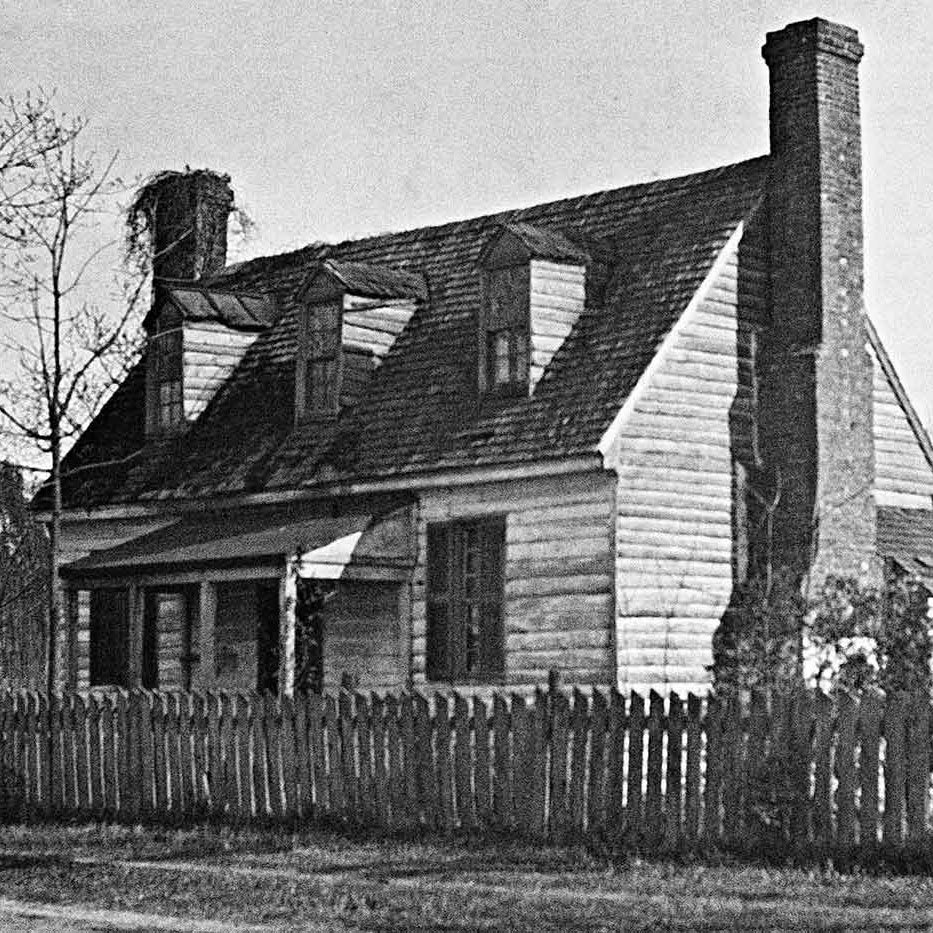
1930s photo, a brick smokehouse at Shirley Plantation. The cement stucco skin
protects the bricks from salt damage.

 Click image to enlarge |
Foursquare and Stolid, These Buildings Were a Hardworking Adornment to the Colonial Backyard
by Michael Olmert
Summertime, in the eighteenth century, was no
time for eating fresh pork. The oppressive heat that made quick work of humans
in the Middle Atlantic colonies also turned the choicest cuts of meat into
Petrie dishes of corruption. The day a pig was slaughtered, it was cooked and
eaten, often as part of a family celebration or for the arrival of important
visitors. Leftover meat was quickly shared with neighbors or slaves.
A frosty month, especially December, was the proper time for
pig butchering, salting, and smoking. It's a tradition documented to medieval
times. The illuminated manuscripts known as books of hours, prestige prayer
books, often depict pig slaughtering on their calendar page for December, in
the same way that they show planting in March and harvesting in August. Killing
the winter pigs was just another part of the annual agricultural round.
If you expected to have pork all year long, you needed a
smokehouse. From earliest times, a smokehouse was a small enclosed shelter, a
place in which a fire could be kept smoldering for a few weeks, which would
only slowly release its smoke, and in which the smoked meat could hang safe
from vermin and thieves.
Just about any sort of vernacular shed could serve. But an
elegant Gothic one appears in a book of hours painted in France by the
so-called Rohan Master about 1420. On the page for December, a pig is being
slaughtered, a wooden tub sits ready for the salted meats, and a fire has been
kindled in the little smokehouse. Not that all those necessary tasks are meant
to happen on the same day.
In essence, you cure meat in two steps. The fresh cuts are
packed in tubs of coarse salt for about six weeks while the salt draws most of
the water from the flesh. Then the salted meats are hung in a tightly
constructed wooden shed, usually without windows or a flue, in which a fire
smolders for one to two weeks. The result is dried, long-lasting,
smoke-flavored meat that will age in the same smokehouse for two years before
it's eaten.
Smokehouses don't show up in the documentary or
archaeological record of seventeenth-century Tidewater. If they're smoking meat
at Jamestown, they're doing it in ephemeral sheds or barns, not in
purpose-built structures. Or the task may have been done as it often was in
England, in smoking closets tucked away inside chimney flues. But since so very
little remains of Jamestown above foundation level, it's impossible to know for
sure.

 Colonial Williamsburg interpreter Barbara Ball butchers a hog in wintertime,
the time a hog could be prepared for smoking without spoiling.

 Click image to enlarge | 
 The
winter slaughtering of a pig in a fifteenth-century book of hours. A smokehouse
was the next destination for the meat.

 Click image to enlarge |
By the first half of the eighteenth century, a new class of
building is regularly appearing in the backyard landscape: the smokehouse,
alternatively spelled "smoak" house. Typically, these are cubical structures of
wood, eight to fourteen feet square, with steep pyramidal roofs for holding in
the smoke among the hanging cuts of meat. It's at this time that the word first
shows up in written records, according to the Oxford English Dictionary and Carl R. Lounsbury's Illustrated
Glossary of Early Southern Architecture and Landscape.
In 1716, there's a mention of a smoak house on a plantation
in York County, Virginia, the earliest known use of the term. A Hanover County
plantation listed for sale in the Virginia Gazette on January 7, 1742, points to its
"new fram'd Smoak-house, 8 Feet Square." In 1732, "a Smoak house eight foot
square" with a "planked Dore," is ordered for the glebe of Newport Parish, Isle
of Wight County, Virginia. The sturdy door is to do with security. After the
fires went out, the meat was stored in there. Poachers had to be kept at bay.
Everyone needed a smokehouse. At Colonial Williamsburg, of
the eighty-eight original structures that survive, twelve are smokehouses. And
an additional fifty reconstructed smokehouses dot the backyards of the Historic
Area, many built atop the foundation footprints of likely smokehouses. At the
Governor's Palace, the Wythe House, and the Peyton Randolph House,
reconstructed smokehouses are still used to cure and flavor pork.
Sometimes a smokehouse is also called a meat house, which
makes sense because the building spends much more of its time as a storage
locker than it does as a smoking house. In 1778, a house on Custis Square in
Williamsburg is said to come with a meat house. In Maryland, the phrase "meat
house" seems to be preferred over smokehouse. In Sussex County, Delaware,
however, there was a farm with a meat house and a smokehouse, according to an
Orphans Court valuation of 1812.
In Virginia, meat house is the exception. In the List of
White Persons and Houses taken in the County of Halifax, 1785, there are
fifteen "smoak" houses and one meat house. This record is useful for looking at
smokehouse sizes: Of the fourteen Halifax structures the dimensions of which
are listed, five are twelve-by-twelve feet, five are twelve-by-ten feet, and
the rest are twelve-by-eight, ten-by-ten, eight- by-eight, and sixteen-by-
sixteen. They must have seemed like near-perfect little cubes, part of an
impressive parade of useful and well-made outbuildings in the colonial
backyards, the hallmark of a society that wanted to be seen as tasteful, well
managed, civilized.
A sense of how the smokehouse was made and used is plain in
Thomas Cooper's report of what life was like on the ground in North America, in
a book published in London in 1795. He's describing the large plantation of one
Archibald M'Allister in Paxtang, Lancaster County, Pennsylvania:

 The
smokehouse is one of Colonial Williamsburg's Peyton Randolph House outbuildings
that have been reconstructed on the urban plantation. It was part of the
"dirty" zone, separated by a fence from the clean area of the dairy and
kitchen.

 Click image to enlarge |
His smokery for bacon, hams, etc. is a room about twelve
feet square, built of dry wood a fireplace in the middle, the roof conical,
with nails in the rafters to hang meat intended to be smoaked. In this case a
fire is made on the floor in the middle of the building in the morning, which
it is not necessary to renew during the day. This is done for four or five days
successively. The vent for the smoke is through the crevasses of the boards.
The meat is never taken out 'till it is used. If the walls are of stone, or
greenwood, the meat is apt to mould.
All this rings true and speaks to several design
commonplaces in historic smokehouses. Carl R. Lounsbury, an architectural
historian at the Colonial Williamsburg Foundation, thinks the centrality of the
heat source, a firebox in the middle of the floor, drives the building's square
shape. And the sharply pitched roof is essential for containing heat and smoke.
Water
inside the meat is a problem. It spoils everything. Dried meat lasts longer.
And so the heat and smoke are meant to drive off the water. "Some smokehouses
have a small square fire pit; some have bricks covering the floors; some have
plain dirt floors," Lounsbury says. The more intricate the roofing timbers, the
more places to hang meat. "Sometimes," he says, "you find extra collar beams up
there. And we've seen all manner of pegs, nails, hooks, and chains for hanging
meat."

 The Peyton Randolph kitchen Barbara Ball rubs
salt into a ham before smoking.

 Click image to enlarge | 
 Interpreter Jim Gay ties a leather string
through a ham.

 Click image to enlarge | 
 In the smokehouse, interpreter Rob Brantley hangs hams.

 Click image to enlarge | 
 Interpreter Dennis Cotner checks for mold.

 Click image to enlarge |
Another way of removing water is with salt. The job starts
by working a mixture of twenty-five pounds of salt and two pounds of brown
sugar deeply into every inch of the fresh meat. Two ounces of saltpeter are
added so the meat will retain its pinkish color. It's a tough job that can only
be done by hand.
At Colonial Williamsburg, the second Saturday of December is
the traditional day for salting pork. "After the hand salting," says food
historian Frank Clark, "we dry pack the pork in tubs, forcing the meat and
coarse salt in as tightly as we can. Each tub has several large holes in the
bottom for the 'liquor' to drain out into the dirt floor." That liquor is the
unusable and faintly-not-nice water drawn off by the salt. It's dehydrating the
meat, replacing water with salt. The tubs appear to be truncated half-barrels,
resembling the wooden tub in the Rohan book of hours, a scene nearly six
hundred years old.
The colder the weather, the slower the liquid flows out of
the meat. Still, after about six weeks in the salting tubs, the cuts are ready
for hanging over the smokehouse fire. At Colonial Williamsburg, the fire is
usually kindled in February. Because the whole point is smoke, not flame, green
wood is used, though historically corncobs or fruitwood smoked well enough. At
Shirley Plantation, whose smokehouse was last used in about 1953, apple wood
was burned, according to proprietor Hill Carter. It added a special sweetness to
the meat. Also at Shirley, the fire was allowed to burn untended day and night.
It was relit every morning. "It wasn't a disaster if it went out," Carter says.
Typically, smoking would last about two weeks.
The reconstructed Wythe smokehouse is so solid, its wallboards so tightly
fitted, it's more like a piece of outdoor furniture. It holds in its smoke well
and is the most efficient smokehouse in town.
The more vernacular smokehouse behind the Peyton Randolph
House leaks profusely. In keeping with that backyard's orientation, the
smokehouse uses two types of boarding on its four sides: sawn poplar
weatherboards for the sides facing the house and more formal yard but riven oak
clapboards for the sides invisible from the house. Wool has been stuffed into the
crevices between the irregular clapboards. With more oxygen getting inside this
smokehouse, its fire burns brighter and faster, but it loses so much smoke it
takes much longer to cure the meat.
More smokehouses were like the Peyton Randolph version than
the Wythe's. People who grew up around working smokehouses a half century ago
recall the comforting sight of them in the landscape, puffing away at their
wintery task like steam engines.
Not that smoke is an unalloyed blessing. Inside an old
smokehouse, the studs and walls appear black and shiny, like the oily-feathered
back of a grackle, the layer of creosote deposited by years of smoke. And since
the hams, shoulders, and bacons age inside the smokehouse for at least two
years, they can be exposed to several more rounds of smoke. Creosote begins to
coat the meat. This may be why, at Shirley, cured meat was removed from the
smokehouse and rehung in the basement of the big house. "Some of it went three
to four years," Carter says. "Some of it the rats got."
Since insects, too, have a taste for bacon, the tighter the
smokehouse, the better. But some always managed to get inside. For them, the
cured meat was coated with pepper, a natural insect repellent. Hickory ashes
were another way of discouraging bugs.
A smokehouse that's too tightly constructed can be trouble. Elevated
humidity inside can lead to gray and green blooms of mold on the hanging meat.
"You have to be careful about bright molds," Clark says. "Bright greens or
purples can be nasty. The duller molds and the creosote can just be washed or
cut off the meat. No harm done."
Salt, though lovely for meat, is a problem for smokehouses.
After a century or more of use, the wood cells of timber get infused with salt,
which replaces their water, and the studs go all fuzzy and soft. Deep down the
wood can be fairly competent, but the surface is pure Nerfball.
Brick smokehouses are especially threatened by salt
intrusion. Lavishing the investment of bricks on a utilitarian building devoted
to a smoky, almost industrial use was pure ostentation. Still, stunning
examples of brick smokehouses exist at Shirley, at His Lordship's Kindness near
Clinton, Maryland, at Reynolds' Tavern in Annapolis, and at the Benjamin Powell
House at Williamsburg, to name a few.
They're unusual, if not quite rare, often plagued by salt
intrusion that leaves the bricks and mortar friable. Decades of degradation
have given the bricks the rounded and insubstantial appearance of damp sugar
cubes. The Powell smokehouse had gone so granular that hundreds of finches were
pecking it away, either for the salt or for the tiny stone grains they use in
digestion. The solution was to blot the building with seven applications of a
shredded-toilet-paper poultice, which drew out thirty-eight pounds of the
offending salt.

 A
recent photo of Shirley's brick smokehouse.

 Click image to enlarge | 
 The Powell House
smokehouse in Colonial Williamsburg's Historic Area.

 Click image to enlarge | At Shirley, the solution was to render the walls with a
covering of cement stucco, a fix that was tried at the Powell House in the
1820s but was removed in the restoration of the building in 1956. The Shirley
stucco is still in place, still doing its job.
So what is
it all about, this quest to
understand smokehouses and to reconstruct them in believable ways that reflect
eighteenth-century life? For Edward A. Chappell, director of architectural
research at Colonial Williamsburg, God is no longer just in the details.
"We won't copy bits of a historic smokehouse for a
reconstruction," Chappell says. "We try instead to understand the system: how
and why and where this building was built, how it fit into a complex zone of
backyard activities. Building details are helpful, but the relationship between
buildings is what's most interesting. So we record the whole plan of the
farmyard during fieldwork, not just louvres and hooks and hinges."
The reconstructed Peyton Randolph smokehouse is an example
of an older building that got a facelift when the family began to transform its
property in the 1750s. Its clapboard sides, facing away from the house, were
refitted with more finished and expensive weatherboards.
"In time, we came to understand," Chappell says, "that in
the Peyton Randolph backyard there was a palpable division of activity. Zone A
was for clean work; the dairy was there. Zone B was for more unsavory and
industrial work. And although the smokehouse is more or less balanced by the
dairy, its door shouldn't open into Zone A. There's even a fence between the
two zones."
And so the door will be moved from the south to the north
side of the smokehouse, opening into zone B, not into the cleaner zone, near
the slaves working in the laundry and kitchen and the Randolph women making
butter and cheese in their spotless dairy. It's a change driven by new
archaeology and a clearer understanding of this particular backyard.
There was once a time when these zones, these
interdependencies, defined people's lives. There were always distinctions
between the field and the house, of course. But these new fences, these mute
zones centered on the smokehouse and the other backyard outbuildings, they were
there too, a real part of the circle of common knowledge we are only now
uncovering. It was a world built on boundaries.


Michael
Olmert teaches English at the University of Maryland. He is compiling his
earlier stories that appeared in the journal—on ice houses, dovecotes,
privies—into a book.

|  |
|