|
CW Journal
: Summer 03 : Cabinetmakers Preserve Colonial Craftsmanship


Colonial Williamsburg's cabinetmakers,
from left, Kenneth Nuttle, David Salisbury, Kaare Loftheim,
Master Mack Headley Jr., and David Wait


Click image to enlarge |
Cabinetmakers
Preserve Colonial Craftsmanship by
Ed Crews
Colonial Williamsburg's master cabinetmaker studies eighteenth-century
furniture, examining the joints, carvings, and finish of a desk or
table or chair, frequently marveling at the skills and artistry of
the craftsman who made it. "When I look at a piece of old furniture,
I often am humbled by the subtleties, thoughtfulness, and refinements
I find," Mack Headley Jr. said. "The person who created it tried to
make it special and to give it a personality. You can still see these
qualities today, more than 200 years after the work was completed."
The son, grandson, and great-grandson of furniture makers, Headley
has scrutinized, repaired, restored, and reproduced antique furniture
for almost four decades. He began as a teenager during the late 1960s
in his father's Clarke County, Virginia, shop. Headley joined Colonial
Williamsburg in the late 1970s and heads the interpretive and craft
efforts at Hay's Cabinetmaking Shop on Nicholson Street, working with
journeymen Kaare Loftheim and David Salisbury, and apprentices Ken
Nuttle and David Wait. "At the shop, we try to rediscover
and preserve the eighteenth-century cabinetmaker's trade," Headley
said. "This is mostly done by replicating Tidewater furniture. We
use antiques as patterns. From them, we learn about the furniture's
structure and decoration. "Eighteenth-century furniture was
artistically and structurally more refined than in any period previously
or subsequently."


A clothes press by Thomas Chippendale,
whose design book shaped English and American taste in furniture.


Click image to enlarge |
Economics were the primary reason. Before 1650, fine furniture was
a rarity in western Europe and North America. Generally, people neither
needed nor could afford it. They made do with simple but serviceable
pieces. That changed when international trade fueled a business boom
and created a middle class hungry for status, comfort, and more wealth.
"The furniture was about more than function," Headley said.
"The middle class was networking and socializing. If you wanted to
participate in the economy, then you needed certain things to facilitate
your success. Furniture was part of the process."
The market's appetite for furniture stimulated the creation of cabinetmaking
shops across Great Britain and British North America. Although cabinets
were a specific type of furniture, the term "cabinetmaking" applied
to all furniture construction. By the mid-1700s, superb products were
coming from top English shops, like Thomas Chippendale and Vile &
Cobb, which served King George III. Some wealthy Virginia planters
imported furniture. Most buyers, however, patronized Tidewater craftsmen.
Williamsburg became the colony's leading furniture production center.
By the 1770s, the town had six shops catering to merchants, planters,
tradesmen, and politicians from across the state, including Thomas
Jefferson. Peter Scott and Anthony Hay, among others, had long, successful
Williamsburg careers.
Bostonians and Philadelphians liked furniture elaborate in construction
and decoration. Virginians, however, preferred their furniture "plain
and neat," which implied modest elegance and solid construction. Practical,
they wanted attractive yet durable items. Though Williamsburg-made
furniture rarely achieved the pinnacle of top British craftsmanship,
domestic goods often compared favorably with second-tier British products,
like those from the shop of Philip Bell.


A 1770s chair by Williamsburg cabinetmaker
Peter Scott.


Click image to enlarge |


A John Selden clothes press, at Shirley
Plantation.


Click image to enlarge |
Like their European counterparts, successful Virginia craftsmen had
to combine contemporary technology, artistic sensibility, and skill.
An apprentice cabinetmaker had to learn much. He had to master such
tools as saws, planes, drills, spokeshaves, drawknives, and chisels.
Then, he used them to perfect construction techniques—dovetails
and mortise and tenon. He also learned how to apply finishes and what
kind of finish to apply—high gloss to reflect candlelight, or
something understated to bring out a grain. An apprentice with ambitions
of owning a shop also had to become adept at reading, writing, arithmetic,
geometry, and bookkeeping.
The trade required artistic and aesthetic sensibilities. Masters usually
tried to develop these in apprentices by having them practice drawing
and study design books about Greek and Roman architecture. Particularly
popular were the ten books of architecture by the Roman Vitruvius.
Cabinetmakers who learned classical ideas about balance and applied
them transcended craft and entered the realm of art. "I think
the most interesting thing about eighteenth-century cabinetmaking
for me is the wonderful refinement of proportion and line," journeyman
Loftheim said. "And it is probably the area that I understand the
least. It's not accidental that the forms of many period pieces still
set so well with us today. They understood that attractive physical
spaces have a mathematical-geometrical relationship."
According to Headley, the most important knowledge a cabinetmaker
needed was a full appreciation of the interaction of his tools and
wood. This meant understanding wood growth and how to use it to advantage.
Apprentices quickly learned that these properties varied with wood
types. Virginia furniture was made from American black walnut, mahogany,
poplar, yellow pine, oak, and beech. For all, cabinetmakers had to
be aware of how Virginia's humidity made wood shrink and swell, and
how to construct furniture to allow for it without splitting.
Of all the items of furniture, chairs could test their abilities most.
"Chairs are generally considered the most challenging form in the
trade to master," Loftheim said. "There are so many things that have
to come together. Many of the skills required are layered on top of
skills previously learned. Everything is angled; nothing is simply
at 90 degrees. Parts are relatively small in cross-section, and you're
supposed to be able to sit on it."
Cabinetmakers also had to work fast. In a preindustrial age, the slowest
cabinetmaker was often the least successful. Speed was affected by
materials, size, finish, and ornamentation. A fancy desk with an attached
bookcase might take 600 hours of work. Most of that was in planing
and sawing. A simple chair might require thirty to thirty-five hours.
Although eighteenth-century cabinetmakers could create beautiful furniture
in a comparatively short period, individual craftsmen could not compete
with the quantity or price of mass-produced goods made in factories
during the Industrial Revolution. Handmade furniture all but disappeared
by the 1850s.
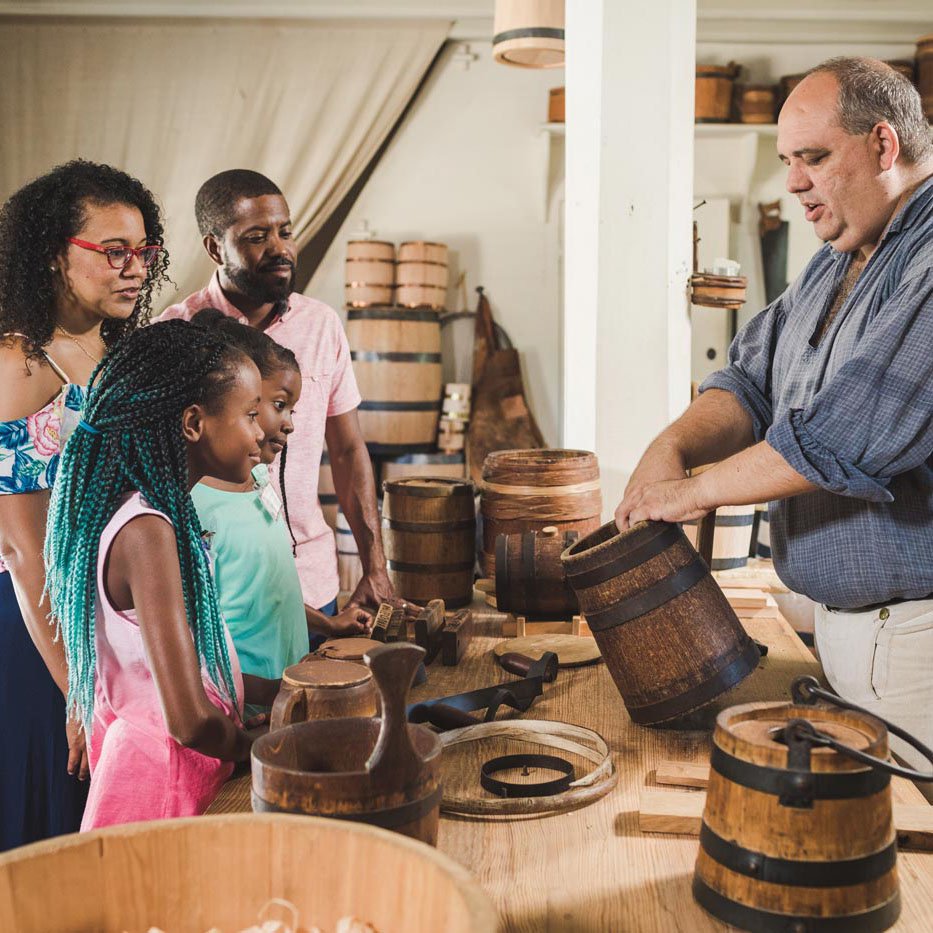
Today, the cabinetmakers at the Hay's shop are recapturing and preserving
eighteenth-century skills. The shop is filled with workbenches and
tools. Wood shavings litter the floor. Sunshine streams through large
windows, providing good natural light for detail work.
Here, Headley and his colleagues labor on projects designed to expand
their knowledge of Tidewater workmanship. Recent projects have focused
on the furniture of Williamsburg's Peter Scott. Modern apprentices
are getting in-depth experience, replicating some of his chairs. Other
projects ahead include a bureau table, a writing table with inlay
work, and a tall case clock, which will be studied at Colonial Williamsburg's
2004 woodworking program.
The shop is on a quest for knowledge and mastery of the cabinetmaker's
art. That means building reproductions, studying antiques, and, every
once in a while, seeing in them the still-living craftsmanship of
an earlier age.

Kenneth Nuttle prepares to turn a wheel
lathe. |

Kaare J. Loftheim adjusts a plane blade.
|

David Wait clamps a piece of wood into
a vise on the workbench. |

David P. Salisbury adjusts a vise to
hold a piece of wood. |

Master Cabinetmaker Mack S. Headley
Jr.
pauses in front of the wheel lathe
in the Hay's Cabinetmaker Shop. |

Quicktime video excerpts from Colonial Williamsburg's
"The
Art and Mystery of the Cabinetmaker Crafting a Card Table" video.

Learn more:

Richmond writer Ed Crews is the author
of a long-running journal series on colonial trades. His story on
carpentry appeared in the spring 2003 magazine.

|  |