Page content
Resize textResize textResize text largerEmail pagePrint pageShare this page
View related multimedia and links

Conferences, Forums, and Workshops at Colonial Williamsburg

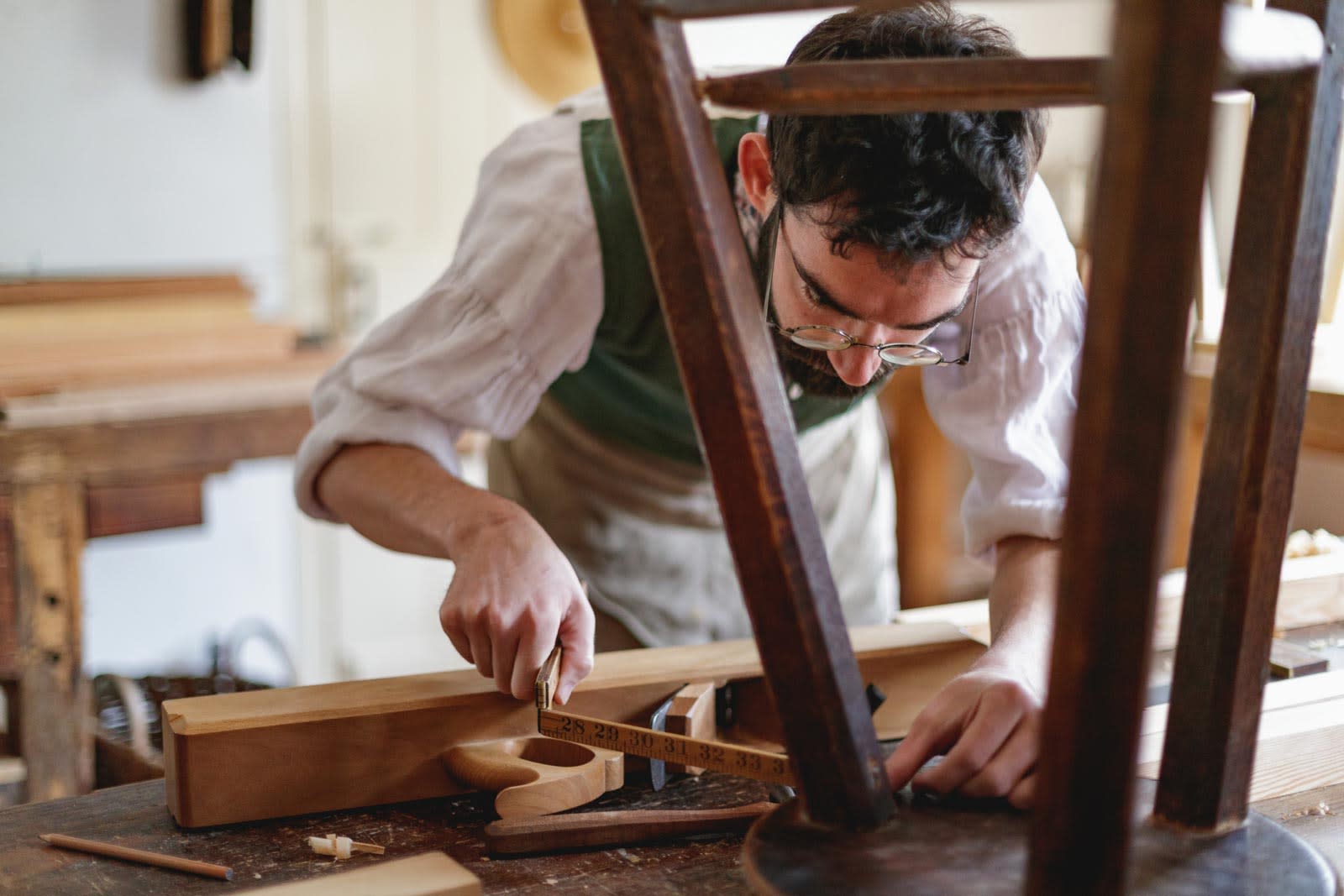
Working Wood Demonstration

The office of Conferences, Forums and Workshops presents a broad range of high-quality programs that address issues of historical and contemporary significance as well as focusing on the decorative arts, material culture, historic trades and horticulture. Skilled professionals at Colonial Williamsburg are joined by distinguished members of the academic and professional communities to present these programs.

Join us for the Garden Symposium, Working Wood, the Antiques Forum, and other programs for a rewarding learning experience.

Please bookmark this site and check back frequently for new offerings. Special conference rates are available for programs at the official hotels of Colonial Williamsburg. To make room and dining reservations, call Monday through Friday, from 8:30 a.m to 5 p.m.

Program Information and Online Registration

2010

January 13-16 and 17-20

Furniture
image credit: Thomas Jefferson Foundation / Monticello

Working Wood in the 18th Century
Thomas Jefferson’s Furniture and Woodwork

Cosponsored by
Fine Woodworking and

Colonial Williamsburg and Fine Woodworking are pleased to be joined by Thomas Jefferson’s Monticello to present the twelfth annual Working Wood in the 18th Century conference at Williamsburg during the week of January 13-20, 2010.   The topic is one we are especially excited about: Thomas Jefferson’s Furniture and Woodwork.

The program will begin with an overview of Jefferson’s Monticello and its furniture by Monticello senior curator and vice president Susan Stein.  Bob Self, Monticello’s conservator of architecture and furniture, will introduce us to the Monticello joinery, its woods, tools, and workers.  Then, Bob will join Mack Headley and the staff of the Colonial Williamsburg Historic Trades Cabinetmaking Shop to present the design and construction of three pieces of Jefferson furniture: a stand-up writing and drawing desk; a tripod-base, revolving-top table with drawer; and one of the iconic Campeachy chairs that were Jefferson favorites.   Colonial Williamsburg joiners Garland Wood and Ted Boscana will reproduce the mantel in Jefferson’s personal bed chamber—Jefferson’s original drawing of it survives--and look at other aspects of Monticello’s joinery.   Roy Underhill will present the construction of Jefferson’s revolving bookstand and ideas about furniture that Jefferson likely encountered in France.   As always, these demonstrations will concentrate on period methods of workmanship, and close-up video monitoring will show the processes in detail. 

As special treats, we are planning to have one or two pieces of original Jefferson furniture on loan from Monticello for the conference.  We are likely to converse with Mr. Jefferson himself, in the person of Bill Barker, who skillfully discusses just about any aspect of Jefferson’s life, accomplishments, and philosophy.  And, for those of you who can make it to Charlottesville coming or going, Monticello will be offering special house and furnishings tours and other activities developed specifically for conference attendees.

Speakers Include:

  • Bill Barker, founding father interpreter, Colonial Williamsburg
  • Ted Boscana, journeyman carpenter and joiner, Colonial Williamsburg
  • Mack Headley, master cabinetmaker, Colonial Williamsburg
  • Bill Little, volunteer cabinetmaker, Colonial Williamsburg
  • Kaare Loftheim, journeyman cabinetmaker, Colonial Williamsburg
  • Bill Pavlak, apprentice cabinetmaker, Colonial Williamsburg
  • Jane Rees, researcher, author, editor of the Tools and Trades History Society Journal.
  • Robert L. Self, conservator of architecture and furniture, Monticello
  • Susan R. Stein, Richard Gilder Senior Curator and Vice President for Museum Programs, Monticello
  • Roy Underhill, author, teacher and host of the PBS series The Woodwright’s Shop, Williamsburg, Virginia
  • Matthew Webster, conservator of architecture, Colonial Williamsburg
  • Brian Weldy, apprentice cabinetmaker, Colonial Williamsburg
  • Garland Wood, master carpenter, Colonial Williamsburg

The conference is informal. Participants’ comments and questions are welcomed.  During morning and afternoon breaks, speakers display their work, tools, and materials; demonstrate techniques; and chat with participants.  To include more participants while keeping the conferences small enough for everyone to be involved, two identical programs are offered. 

Download brochure (requires Adobe Acrobat Reader)

Please note: Session 2 is sold out. To place your name on the waiting list for Session 2, please call 1-800-603-0948.

Register online


February 7-11

chest

“Well made & Exceeding Fine”: The Decorative Arts of New England
62nd Colonial Williamsburg Antiques Forum

Scholars have been documenting the arts and crafts of early New England for more than a century and a half, but new and exciting discoveries continue to be made on a regular basis.  At the 62nd Colonial Williamsburg Antiques Forum, “Well made & Exceeding Fine”: The Decorative Arts of New England, you are invited to explore this rich and diverse heritage. 

The 2010 Forum will bring together a group of widely recognized authorities on the remarkable furniture, ceramics, textiles, paintings, and buildings that were produced in New England between 1680 and 1830.  More than twenty curators, collectors, and historians will present their latest findings in a series of illustrated lectures and video-assisted workshops.  Scheduled speakers include Jane Nylander, president emerita of Historic New England, scholar and author Kemble Widmer, and noted New England auctioneer Ron Bourgeault.

In addition to the formal program, Forum guests may register for optional hands-on workshops with the Colonial Williamsburg collections and private tours of historic homes in the region.  Please plan to join us February 7-11, 2010, for “Well made & Exceeding Fine”: The Decorative Arts of New England.

Download Bibliography

Download brochure (requires Adobe Acrobat Reader)

Register online


March 18 – 21

Stoneware

Pottery with a Past:
A New Look at Salt-glazed Stoneware Collections, Research, and Archaeology

Recent new discoveries have brought salt-glazed stoneware to the forefront of current collecting and archaeological research. From first English settlement onward, salt-glazed stoneware filled an important role in colonial homes and public houses. Dynamic trade brought a range of manufactured goods, including stoneware, to the New World. During much of the seventeenth century, stoneware bottles and mugs were prized possessions of the wealthiest colonists. But by the third quarter of the eighteenth century, brown, gray, and white stoneware from Germany and England was found everywhere. At that time, it played a role akin to modern-day plastics: ever present and essential, but rarely celebrated. Stoneware was comparatively affordable, extremely durable, readily available, and—in some instances—quite fashionable. This remarkably versatile ceramic also was manufactured successfully in America during the colonial and post-Revolutionary period.

Join Colonial Williamsburg staff members and distinguished lecturers such as David Barker, David Gaimster, Jonathan Horne, and Rob Hunter as they explore the production and distribution of brown, gray, and white salt-glazed stoneware from Germany, Britain, and America. The program celebrates the publication of Salt-glazed Stoneware in Early America by Janine E. Skerry and Suzanne Findlen Hood, and is timed to coincide with the exhibition “Pottery with a Past: Stoneware in Early America.” The first museum presentation of German, English, and American stoneware made prior to 1800, the exhibit is on view at the DeWitt Wallace Decorative Arts Museum at Colonial Williamsburg.

Salt-glazed Stoneware in Early America, the accompanying exhibition, and this conference are made possible through the generosity of the Richard C. von Hess Foundation.

Download brochure (requires Adobe Acrobat Reader)

Register online


April 11 and 12

Garden

64th Annual Garden Symposium
Timeless Lessons from Historic Gardens

Period gardens at Colonial Williamsburg and other historic sites provide an infinite selection of ideas that can be adapted effectively to the modern home garden. Whether you are interested in designing a formal garden, growing heirloom plants, or making a garden structure, there are many lessons to be learned from historic gardens. Colonial Williamsburg’s 64th annual Garden Symposium will focus on design concepts, gardening techniques, and plant selections that have stood the test of time. Speakers will emphasize the elements of traditional gardens that can be customized easily to smaller, residential settings. The symposium will include both general sessions and optional afternoon activities. Please join us for Timeless Lessons from Historic Gardens.

Download brochure (requires Adobe Acrobat Reader)

Register online


October 17-20

Accessories


Reconstructing Richard Charlton’s Coffeehouse


2011

March 13-16

Accessories

Costume Accessories: Head to Toe


* Brochure downloads require Adobe Reader

Get Adobe Reader

Colonial Williamsburg Foundation
Post Office Box 1776
Williamsburg, VA 23187-1776

Fax: (757) 565-8921
Telephone: (757) 220-7255
Toll free: (800) 603-0948
Email: dchapman@cwf.org


Multimedia and related links

  • slideshows
  • videos
  • podcasts
  • Interactive
  • Video

  • Snowy Historic Area

    Snowy Historic Area

    Silent video of first snowfall January 2010

    Launch

  • 75 Years of Costume Design

    75 Years of Costume Design

    Colonial Williamsburg marks 75 years of costumed interpretation. November 02, 2009

    Launch

  • A Splendid Coincidence

    A Splendid Coincidence

    Inspiration intersects with means in a partnership that resurrects a city. Character interpreter Ed Way portrays W.A.R. Goodwin at Colonial Williamsburg. November 3, 2008

    Launch

  • Restoration and Reconstruction

    Restoration and Reconstruction

    Putting an 18th-century face on a 21st-century building is a feat of research and resourcefulness, explains Colonial Williamsburg architect Scott Spence. September 1, 2008

    Launch

  • What's an EFT?

    What's an EFT?

    Director of Educational Program Development Bill White and his team create a television broadcast to nurture citizens for a new era. April 6, 2009

    Launch

  • more...

  • Related Information