Page content
View related multimedia and linksBasketmaker
- Baskets necessary for rural family life
- Families made rather than purchased baskets
- White oak preferred material
- Entire family learned the trade
Families made their own baskets
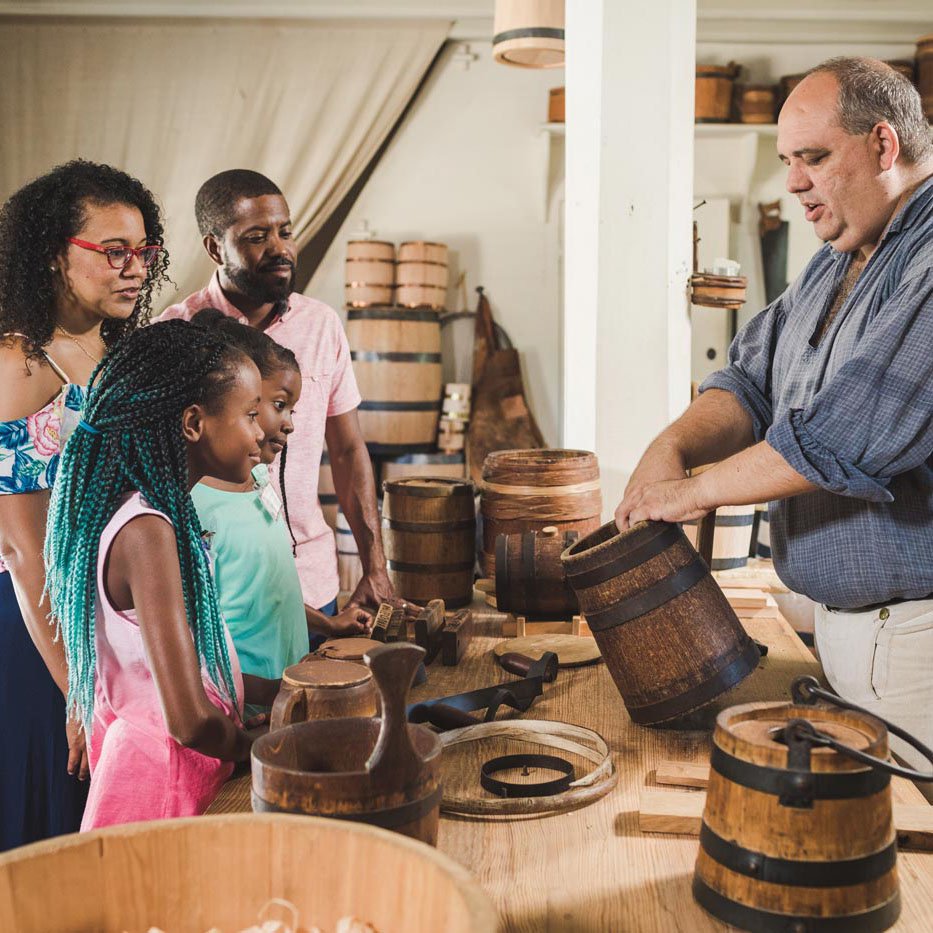
Woven white oak baskets were as useful to colonial Virginians as they were simple, beautiful, and strong. Basketmaking was a domestic activity rather than a business, as families needed baskets of all sizes and shapes for personal family use, and most families made their own baskets – which lasted many years.
American white oak was preferred construction material
Today demonstrated at the Wythe House, basketmaking requires an ax, a few wedges, a large knife, and a supply of saplings. Baskets would have been made from ash, hickory, cedar, and reeds in colonial times. In England, willow branches – called "sallows" if the bark was left and "osiers" if it was stripped – were popular. But England also imported from America the tough and supple white oak the colonists preferred for its tractability and its clear, perfect, straight grain.
Weaving and plaiting required nimble fingers
Basketmakers started with green, six-foot sections of 10-inch diameter logs and split them into sixteenths. They saved the reddish heartwood for basket handles. Slicing along the growth rings, the knife peeled away long flexible, wooden ribbons. The weaving and plaiting required more nimbleness than strength, and both men and women made baskets and taught the children as soon as they were old enough to learn.
Multimedia and related links
-
Podcasts
- View descriptions
-
Basketmaking: A Skill Learned With the Hands
Colonial Williamsburg basketmaker Richard Carr talks about the necessity of basketmaking in the 18th century, and why it has become a rare skill in modern times. November 20, 2006
Audio podcast: Listen (mp3) | Transcript
Image enhanced: View (m4a) | Transcript
-
Prelude to Victory
"Prelude to Victory" celebrates the anniversary of the Battle of Yorktown with three days of special programs that recall September 26, 27, and 28, 1781. September 24, 2007
Audio podcast: Listen (mp3) | Transcript
Image enhanced: View (m4a) | Transcript
-
Fashion and Function
A corset's engineered strictness defines the shape of the 18th-century woman. Journeywoman Brooke Welborn explains the trend. May 5, 2008
Audio podcast: Listen (mp3) | Transcript
Image enhanced: View (m4a) | Transcript
-
Researching Revolutionary Citizens
Actor-interpreter Corinne Dame talks about the continual research necessary to give a living and accurate portrayal of Williamsburg's 18th-century citizens. September 18, 2006
Audio podcast: Listen (mp3) | Transcript
Image enhanced: View (m4a) | Transcript
-
The Gunpowder Plot
Add your shouts to the clamor for revolution in Colonial Williamsburg's evening program, "The Gunpowder Plot." Author Gina DeAngelis explains. September 17, 2007
Audio podcast: Listen (mp3) | Transcript
Image enhanced: View (m4a) | Transcript
-
Emissaries of Peace
Adept negotiators in pursuit of peace, the Cherokee tribe endures through centuries of change. Colonial Williamsburg director and producer Linda Randulfe talks about the November 8 Electronic Field Trip, "Emissaries of Peace." November 5, 2007
Audio podcast: Listen (mp3) | Transcript
Image enhanced: View (m4a) | Transcript
- more...
- Quicktime 7 (free) is required to view the enhanced and video podcasts.
- Subscribe to our podcast RSS feeds:
Audio | Image enhanced | Video
-
Journal articles
-
"Every part works in harmony"
The Venerable Craft of Basketmaking
-
President's Message
A Remarkable Experience
-
Laundries
Largest Buildings in the Eighteenth Century Backyard
-
"The Greatest Practical Approach to Exactness."
The Problem of Apportionment and Washington's First Veto
- more articles...


Shop Online