Page content
View related multimedia and linksSilversmith
Colonial silversmith required talent of an artist
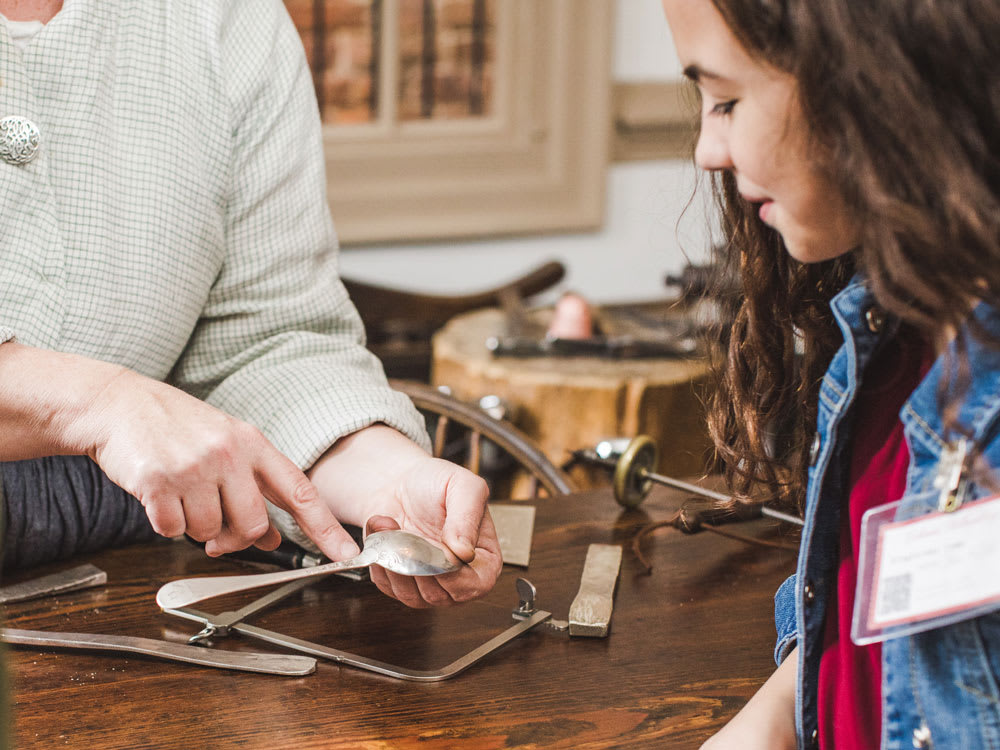
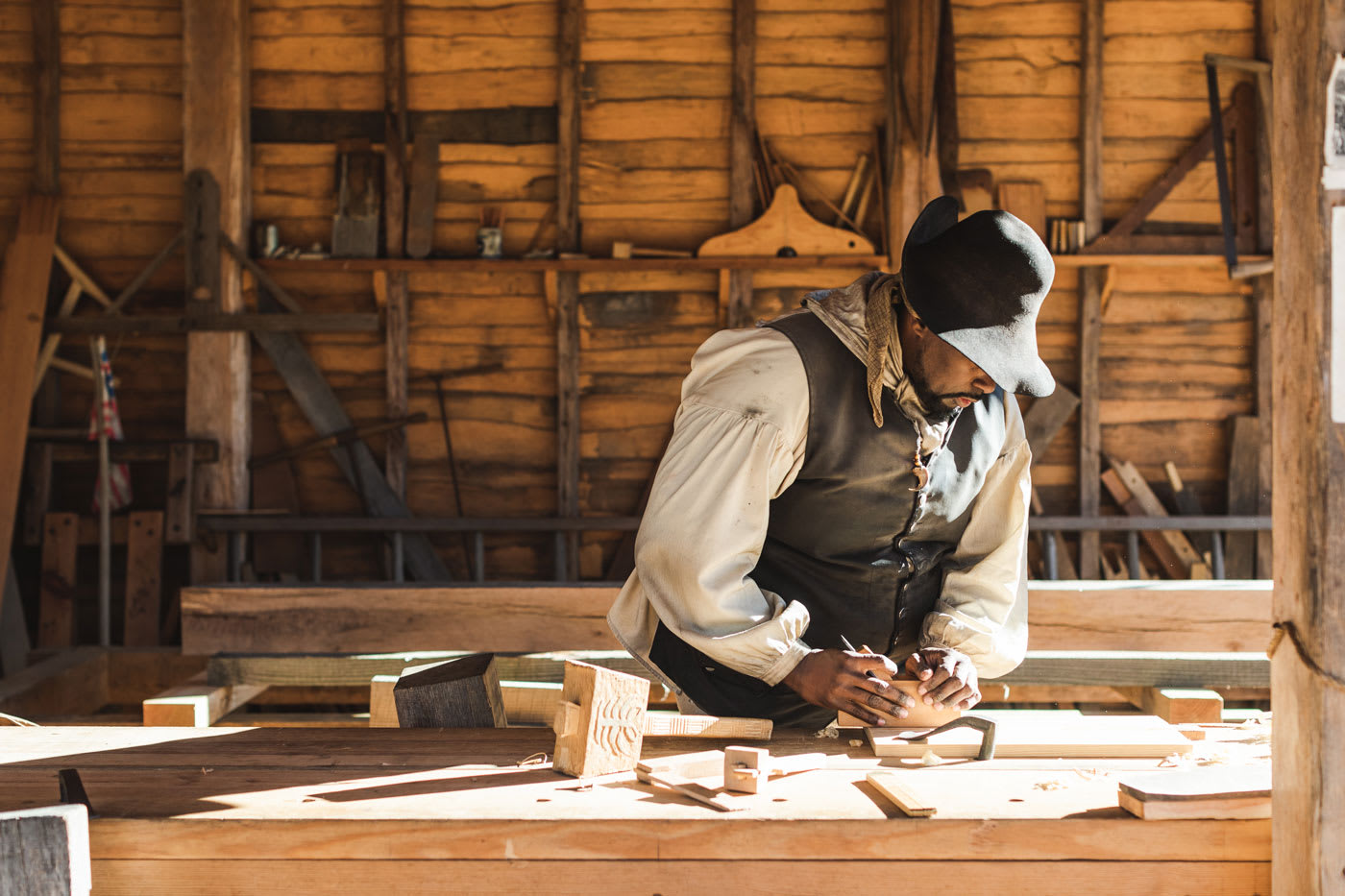
The 18th-century silversmith was thought of as someone akin to a sculptor. Both had to know how to shape their materials with artistic talent, taste, and design.
A contemporary observed that the silversmith was:
"employed in making all manner of utensils . . . either for Ornament or Use. His work is either performed in the Mould, or beat into Figure by the Hammer."
Consider the fashioning of a coffeepot. The silversmith melted sterling in a graphite and clay crucible to about 2,000°. He poured the liquid silver into a tallow-greased, sooted cast-iron mold to produce an ingot. Using a large hammer, he would hot-forge the ingot into a billet – a thick sheet that he would then cut into a circle. Using "raising" hammers, anvils, and stakes, the smith would stretch the piece of silver into a thinner piece as he hammered against the anvils, cupping it into a bowl shape.
Forming sheet of silver into bowl required experience and skill
Hammering the bowl shape against the stakes the silversmith "raised" the body shape by compressing the metal with hammer blows from the outside pushing it inward and upward. When the silver became brittle from working, he heated it red hot and plunged it into an acid bath to keep it malleable. When the smith achieved the body base and lid shapes he wanted, he used small smooth-faced hammers and other stakes to "plannish," or hammer them very, very smooth. The handle sockets, spout, and finial were cast in halves in sand and the two matching pieces were joined with solder. The finished product was polished to a high shine with pumice, rottenstone, and jewelers' rouge. The wooden handle was pinned into the sockets of the gleaming piece, and the coffeepot was complete.
This elegant copy of a mid 18th-century sauceboat was crafted at the Golden Ball in Colonial Williamsburg using 18th-century silversmithing techniques.
Silversmithing today
Today the work of the silversmith proceeds at the Golden Ball silversmith shop in Colonial Williamsburg in much the same way as when colonist James Craig practiced silversmithing there and when James Geddy Jr. practiced the trade at the James Geddy House.
Learn more:
Multimedia and related links
-
Podcasts
- View descriptions
-
Silversmith
Journeyman silversmith Preston Jones reflects on his 26 years of creating silver pieces. August 22, 2005
Audio podcast: Listen (mp3) | Transcript
Image enhanced: View (m4a) | Transcript
-
Zooarchaeology
Zooarchaeologist Joanne Bowen decodes 400-year-old leftovers. June 8, 2009
Audio podcast: Listen (mp3) | Transcript
Image enhanced: View (m4a) | Transcript
Video podcast: Watch (mov) | Transcript
-
Colonial Children's Dance
Youth interpreters in Colonial Williamsburg's Historic Area enliven parlors and stages with dancing demonstrations. Kelly McEvoy details the colonial pastime. August 27, 2007
Audio podcast: Listen (mp3) | Transcript
Image enhanced: View (m4a) | Transcript
-
Jamestown Unearthed, Part Two
With 60 percent of James Fort unexplored, the island outpost guards a wealth of stories. Bill Kelso continues the hunt for discovery. October 8, 2007
Audio podcast: Listen (mp3) | Transcript
Image enhanced: View (m4a) | Transcript
-
The Wren Building
Williamsburg's restoration got underway in earnest with the College of William and Mary's Wren Building, explains Louise Kale, director of the Historic Campus. October 20, 2008
Audio podcast: Listen (mp3) | Transcript
Image enhanced: View (m4a) | Transcript
-
Caring for the Mentally Ill
Williamsburg's Public Hospital was the first facility for the treatment of the mentally ill in British North America. June 11, 2007
Audio podcast: Listen (mp3) | Transcript
Image enhanced: View (m4a) | Transcript
- more...
- Quicktime 7 (free) is required to view the enhanced and video podcasts.
- Subscribe to our podcast RSS feeds:
Audio | Image enhanced | Video
-
Journal articles
-
Tools of the Trades
A Photo Essay
-
Goods
-
Weaving, Spinning, and Dyeing
Dexterity and Detective Work
-
Tools for the Times
Modern Shop Reproduces Antique Implements
- more articles...


Shop Online