Text by Jack Lynch
Photos by Dave Doody
It shall be lawful for any person with
or without orders, to pursue and slay the said Josiah Philips. .
. . - Thomas Jefferson

Attorney
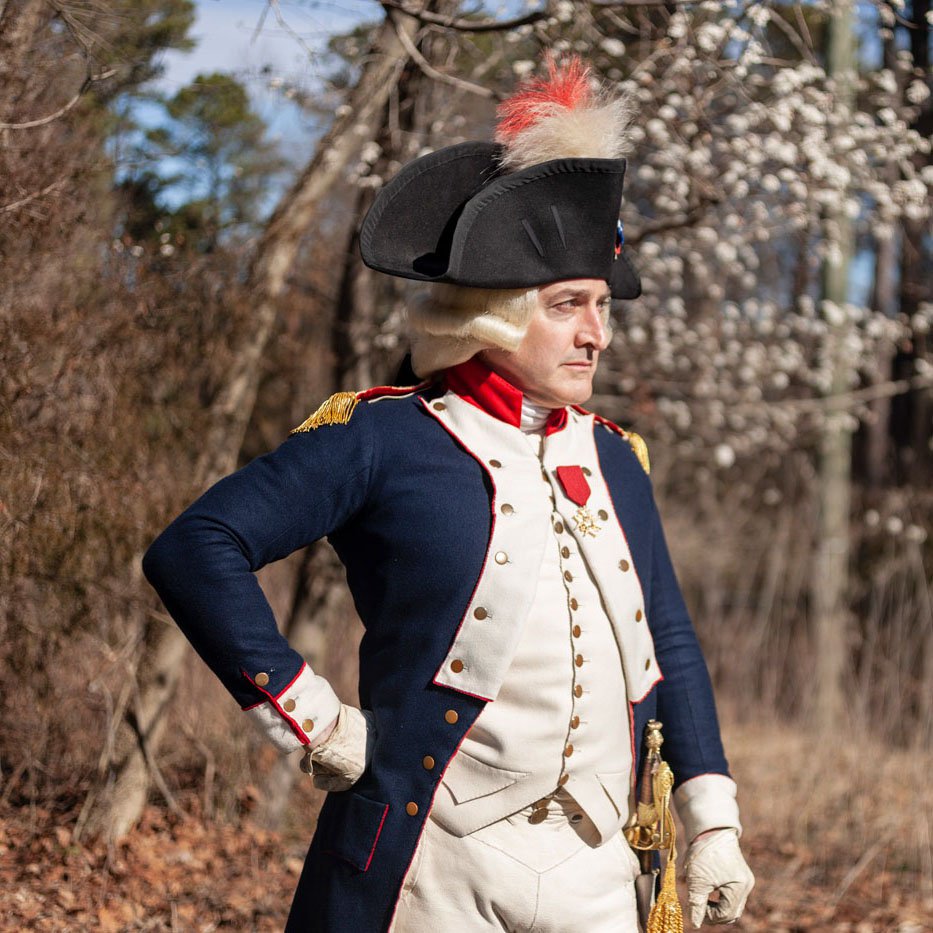
General Edmund Randolph, outlaw Josiah Philips, and the James
City County sheriff portrayed by Daniel Marshall, Ted Bascano,
and Tom Hay - Dave Doody
In the past few months, America has been asking itself when, if ever,
it might be permissible to deprive people of their civil liberties in
the interest of national security. Its not the first time. The
Revolutionary generation had to wrestle with the problem often, and
the answers were sometimes surprising. In 1778 Thomas Jefferson, a champion
of individual freedom, committed what strikes us as a shocking violation
of due process by drafting a bill of attainder.
A bill of attainder is a legislative, as opposed to a judicial, conviction
of a capital offense. When a parliament or congress declares a person
guilty of a high crime, circumventing the due process provided by the
courts, the target is said to be attainted. He is culpable
of felony or treason in the eyes of the government, without opportunity
to defend himself at trial, and his property is seized. Since the bill
outlaws people, not actions, it can convict persons who violated no
laws at all. As the Queen of Hearts said in Alice in Wonderland, Sentence
first-verdict afterwards.
The importance of due process and ordinary judicial proceedings was
paramount when the Revolution began. Virginias Bill of Rights,
adopted in 1776, provided
that in all capital or criminal prosecutions a man hath a right
to demand the cause and nature of his accusation, to be confronted
with the accusers and witnesses, to call for evidence in his favor,
and to a speedy trial by an impartial jury of his vicinage, without
whose unanimous consent he cannot be found guilty, nor can he be compelled
to give evidence against himself; that no man be deprived of his liberty
except by the law of the land or the judgement of his peers.
But Jeffersons bill of attainder, written two years later and
passed by the new states General Assembly, put a man beyond the
protection of the courts and compassed his execution on sight.
Attainder had a long history in English law, the law upon which Britains
colonies modeled theirs. In 1397, Parliament attainted Thomas Haxey
for criticizing King Richard II. Another attainder bill was passed against
Jack Cade, who led an uprising on London in May 1450. In Shakespeares
chronicle of the rebellion, 2 Henry VI, Cades associate
Dick the Butcher announces his plans: The first thing we do, lets
kill all the lawyers. In life, it was the lawyers who had the
last laugh: in 1451, a year after Cades death, lawmakers passed
a bill of attainder to seize his property and, consequently, through
corruption of the blood, to disinherit his heirs.
Not all bills of attainder were aimed at upstarts like Haxey or rebels
like Cade. Many were directed at high-ranking officials or advisers
who had become too powerful or presumptuous. Henry VIII saw attainder
as a useful royal weapon. Charles I, on the other hand, was bullied
by Parliament into signing a bill of attainder against his favorite,
the Earl of Stafford, in 1641. Charles IIs illegitimate son, the
Duke of Monmouth, was likewise brought down by a bill of attainder.
There were occasional complaints about their unfairness, but most people
accepted the acts without serious question. Sir William Blackstone,
the great eighteenth-century English jurist, had no reservations:
When it is now clear beyond all dispute, that the criminal is
no longer fit to live upon the earth, but is to be exterminated as
a monster and a bane to human society, the law sets a note of infamy
upon him, puts him out of its protection, and takes no farther care
of him than barely to see him executed.
| 
Patrick
Henry and Thomas Jefferson, in the persons of Richard Schumann and
Bill Barker, drafting a bill- Dave Doody |
The Baron de Montesquieu, another
scholar of the law, was also comfortable with depriving someone
of liberty by fiat in order to preserve it for the whole
community. . . . There are cases in which a veil should be drawn
for a while over liberty. In A Discourse concerning Treasons,
and Bills of Attainder, Richard West, later lord chancellor
of Ireland, called attainder not only just, but legal, and
even in some Cases absolutely necessary to preserve our Constitution.
But the tide was turning, and over the course of the eighteenth
century attainder was used less often: Englands Parliament
passed its last one in 1798 against the rebel Lord Edward Fitzgerald.
One eighteenth-century English legal scholar declared all attainders
in their own Nature unjust and said, The Law
of England is every Mans Inheritance. . . . Every
Man therefore has reason to conclude all his Actions to be (if
not justifiable) at least unpunishable, so long as the Law does
not take hold of them. In other words, a person could be
called to account for his conduct only by laws already on the
books and not by a statute passed afterward to punish him specifically. |
This was the environment in which the new American states considered
the validity of attainder. Maryland was the first to discard it: the
constitution of 1776 ordered that no law to attaint particular
persons of treason or felony ought to be made. Massachusetts and
Vermont followed suit.
To jump ahead of Jeffersons bill a bit: Alexander Hamilton agitated
against attainder and in January 1784 railed at the doctrine of
disqualification, disfranchisement and banishment by acts of legislature.
The dangerous consequences of this power are manifest. He said
that it could lead to an aristocracy or an oligarchy, in
which no man can be safe, nor know when he may be the innocent
victim of a prevailing faction.
When the Constitutional Convention of 1787 took up the question, all
agreed attainder had to go. The ban on attainder and ex-post-facto-after
the fact-laws was introduced by Elbridge Gerry and James McHenry
on August 22. Several participants hesitated over the provisions on
ex-post-facto legislation; Gouverneur Morris, Oliver Ellsworth, and
James Wilson called them unnecessary and wrangled over their scope.
It passed on a divided vote. The clause on attainder, however, sailed
through nemine contradicente-with no objection.
Article I, Section 9, Clause 3, is explicit: No Bill of Attainder
or ex post facto Law shall be passed. Section 10 expands the scope
of the prohibition to state governments. These clauses appear in the
body of Constitution, not in the appended Bill of Rights. The need of
a fundamental safeguard against bills of attainder was plainer to the
delegates than the bans on self-incrimination and illegal search and
seizure forced on them by the states during ratification.
But few people today know the meaning of what struck the writers of
the Constitution as so disturbing. One legal scholar has called these
probably the hardest clauses in the Constitution for a non-lawyer
to understand. In fact theyre not difficult to explain.
An ex-post-facto law punishes a person for an act that was lawful when
it was done. A bill of attainder is an act that inflicts death on a
person supposed, without benefit of trial, to be guilty of grave offenses.
| No constitutional delegate argued for bills of
attainder, but the practice wasnt unheard of in America;
in fact, they were more common in Revolutionary America than they
ever were in England. Pennsylvania attainted nearly 500 Tories
for high treason in 1776. New York passed a famous bill on October
22, 1779: fifty-nine loyalists-including two former governors,
Lords Tryon and Dunmore, and other high-ranking colonial officials-were
declared guilty of having voluntarily been adherent
to George III, with Intent to subvert the Government and
Liberties of this State. New Yorks constitution had
outlawed bills of attainder, but made an exception for crimes
committed before the termination of the present war,
thereby authorizing more than a thousand attainders during the
Revolution.
The most notorious American bill, though, was written by one
of the most famous advocates for restricting governmental power. |

In
close custody, Philips
endures irons and the
sheriffs indignities.- Dave Doody
|
In his first inaugural address, Thomas Jefferson listed trial
by juries impartially selected as one of the essential American
liberties, and in 1783 he proposed a new Virginia constitution outlawing
any bill of attainder, (or other law declaring any person guilty)
of treason or felony. And yet only five years earlier, he had
been instrumental in passing just such a bill.
In 1777, Josiah Philips, a Tory laborer, began plundering southeastern
Virginia and terrifying the citizens with arson and murder. In May 1778,
Governor Patrick Henry ordered the militia to arrest the noted
Traitor and his fifty followers, but the governments forces
were routed, and Philips and his men went into hiding. Henry turned
to Jefferson-a General Assembly delegate from Albemarle County-who called
for a bill of attainder. Jefferson drafted the bill May 28, and introduced
it to the legislature the same day. It begins:
Whereas a certain Josiah Philips labourer of the parish of Lynhaven
and county of Princess Anne together with divers others . . . have
levied war against this Commonwealth, . . . and whereas the delays
which would attend the proceeding to outlaw the said offenders according
to the usual forms and procedures of the courts of law would leave
the said good people for a long time exposed to murder and devastation.
Be it therefore enacted by the General assembly that if the said
Josiah Philips his associates and confederates shall not on or before
the last day of June in this present year render themselves to the
Governor . . . then [they] shall stand and be convicted and attainted
of high treason, and shall suffer the pains of death.
Jefferson was clear about his reasons: the usual forms and procedures
of the courts of law would result in delays and leave the public
exposed to murder and devastation. The threat was enough
to make him advocate mob justice, deputizing all the population to serve
as summary executioners: It shall be lawful for any person with
or without orders, to pursue and slay the said Josiah Philips and any
others who have been of his associates or confederates. Even associates
or confederates could be legally executed on the spot.
The legality of this bill was shaky. Still, it passed unanimously May
30 after a third reading.
| 
The
modern Dismal Swamp, with its uninviting dark-watered Lake Drummond,
is still wild enough to conceal an outlaw,
as it hid Josiah Philips, from the authorities.
- Dave Doody |
As it happened, Philips was captured
before the law took effect, and Attorney General Edmund Randolph
was uncomfortable with bills of attainder. He tried Philips in
a court of law and, not convinced the evidence of murder and arson
was strong enough to support a conviction, prosecuted on charges
not of treason but of robbery. A jury found Philips and his associates
guilty of stealing twenty-eight hats and five pounds of twine-valued
at just over two pounds-and, since even petty theft was a felony,
they were hanged near Williamsburg in December. |
The legal questions, though, did not end with the executions, and the
bills legacy haunted Henry and Jefferson for years. In Virginias
debates over the federal Constitution, Henry advocated a bill of rights.
Randolph charged him with hypocrisy and reminded the convention of the
Philips case, conveniently forgetting that the bill never reached its
object:
A man, who was then a citizen, was deprived of his life thus:
from a mere reliance on general reports, a gentleman in the House
of Delegates informed the house that a certain man had committed
several crimes. . . . He was attainted very speedily and precipitately,
without any proof better than vague reports. Without being confronted
with his accusers and witnesses, without the privilege of calling
for evidence in his behalf, he was sentenced to death.
Henry and Jefferson were unrepentant. Henry said that the enormity
of his crimes did not entitle Philips to those beautiful
legal ceremonies, which are pointed out by the laws. Jefferson
wrote decades later: I was then thoroughly persuaded of the correctness
of this proceeding, and am more and more convinced by reflection.
In a letter of March 12, 1815, he explained how it was supposed to work:
When a person charged with a crime withdraws from justice, or
resists it by force . . . a special act is passed by the legislature
adapted to the particular case. This prescribes to him a sufficient
time to appear and submit to a trial by his peers; declares that
his refusal to appear shall be taken as a confession of guilt .
. . and pronounces the sentence which would have been rendered on
his confession or conviction in a court of law.
It is not quite true that Philips was given time to appear and
submit to a trial by his peers. The bill had already declared
the usual forms and procedures of the courts of law would
not apply and was clear about the guilt of Philips and his cohorts in
its reference to the treasons, murders and other felonies by them
committed. The arguments about due process arent convincing.
Jefferson is more consistent when he argues that society had a
right to erase from the roll of its members any one who rendered his
own existence inconsistent with theirs; to withdraw him from the protection
of their laws, and to remove him from among them by exile, or even by
death if necessary.
Posterity has not agreed, and the case has baffled many later commentators.
Julian P. Boyd, editor of The Papers of Thomas Jefferson, is
typical. Jeffersons involvement, he says, is, to say the
least, surprising; he calls the bill an extreme violation
of TJs belief in the principle of the separation of powers of
government.
The country has paid less heed to Jeffersons example than to
Hamiltons warning of 1784: Nothing is more common,
Hamilton wrote, than for a free people, in times of heat and violence,
to gratify momentary passions, by letting into the government, principles
and precedents which afterwards prove fatal to themselves.
Jack Lynch, an assistant
professor of English at Rutgers University in Newark, New Jersey,
contributed to the winter 2001-2002 journal Poetic License-Ossian:
The Greatest Poet Who Never Existed He is editor, with Paul
J. Korshin, of The Age
of Johnson: A Scholarly Annual.
|