|
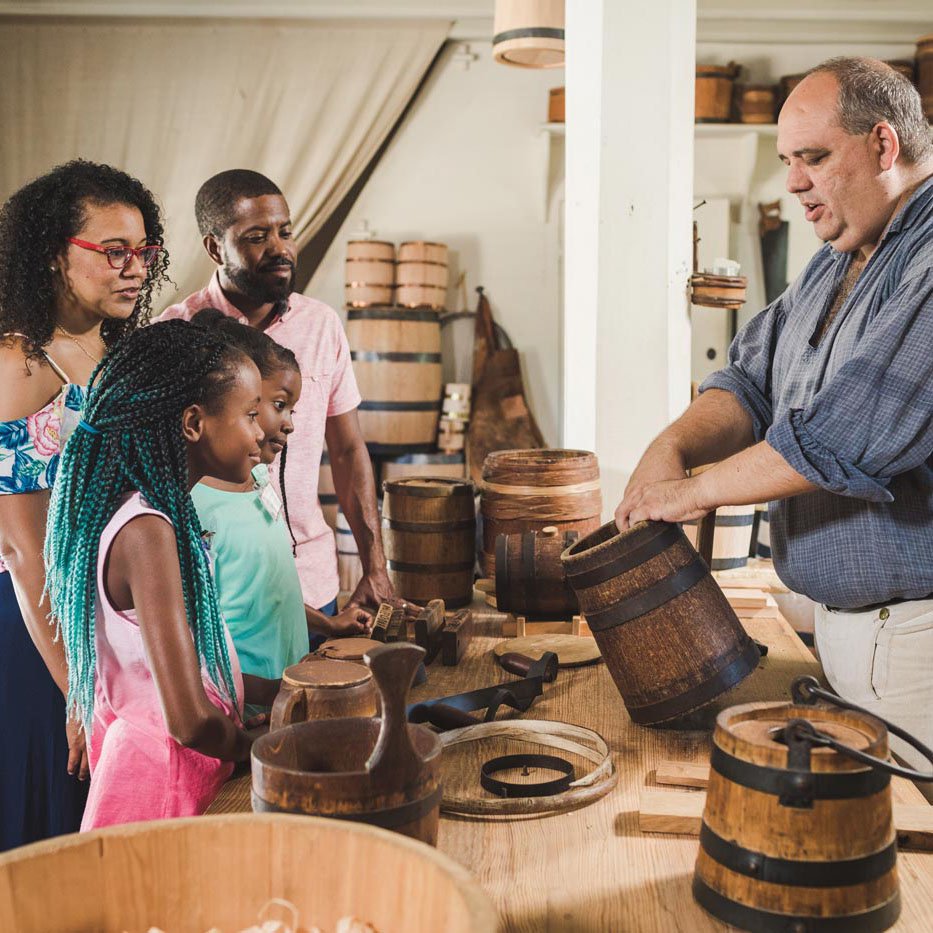
Glossary of TermsApprenticeship: An arrangement by which a young person serves another for a specified period of time and learns the master's (or mistress's) trade. Carpenter: A person who frames houses and often does the interior work as well, such as partitioning, building doors, laying floors, installing moldings and wainscoting. Child mortality: A statistic describing the number of children who die in a given population. Cooper: A person who makes wooden containers such as barrels and washtubs. Gentry: In Virginia, the highest social class. Gentry families owned large amounts of land and numbers of slaves and held the highest public offices. Mantuamaking: The making of various types of gowns for women. Market: A time and place specified by a town for the sale of goods, mostly foodstuffs. In eighteenth-century Williamsburg, the market was held on Market Square once or twice a week (frequency varied during the century). Middling: The middle ranks of society, neither of the highest classes nor the lowest; roughly equivalent to today's "middle class." Millinery: The business of making and selling cloaks, hats, and linen and linen articles, such as aprons and caps, and of selling accessories, such as gloves, muffs, fans, and ribbons. Plantation: A landholding where crops were grown. In eighteenth-century Virginia, a plantation could be any size, from a very small to a very large holding, what would today be called a farm. In the eighteenth century, a "farm" was land rented out to a tenant for growing crops. Suburban: Outside, but bordering on, a town's boundaries. Three "R's": The educational fundamentals: reading, 'riting, and "'rithmetic." Tradesmen: Those who make a living by keeping a shop or producing goods by manual labor, as opposed to those who make their living in the "learned professions." Tutored: Taught by a private tutor or hired teacher. Urban: Of, pertaining to, or living in a town or city. Watermen: In the eighteenth century, men employed in sailing boats on the rivers.
|
|
|
Back to Day
in the Life home page
Copyright 1998 Colonial Williamsburg Foundation |
|