Page content
Teacher Community

Browse the Teacher Gazette archives at our new Teacher Community website.
Membership is free. Join today!
18th-Century Modes of Travel
In the eighteenth century, people traveled for many of the same reasons we
travel todaybusiness, pleasure, or to visit friends and family. Most eighteenth-century
travelers were men from the middling and upper levels of society. Women and
children traveled much less often than men did. Slaves often accompanied their
masters. When a slave traveled alone, he carried a pass from his master showing
that he had permission to travel. Without a pass, African-Americans could be
arrested as runaways.
People moved around the colony by foot, wheeled vehicle, horse, or small boat.
The least expensive and most common way to get from one place to another was
by foot. Walking was the common mode of transportation for poor whites and slaves.
The first step up for a traveler with extra money was the purchase of a horse.
Virginians were extremely fond of horses. Even poor whites purchased a horse
and saddle as soon as they could afford them. Horses sold for as little as £5,
but a fine racehorse cost as much as £500.
Many Virginians also acquired some type of vehicle. Farmers and small planters
found carts or wagons useful. These all-purpose work vehicles hauled produce
to market and carried families on journeys. Wealthier individuals bought riding
chairs, carriages, or coaches. A new riding chair, or lightweight two-wheeled
vehicle, cost £10 to £45, a used chair as little as £2. The
gentry often purchased elaborate vehicles. George Washington, for example, imported
a four-wheeled chariot that cost £315 from England in 1768. Some public
transportation was also available. Stagewagons offered a form of public transportation
along routes between towns, particularly in the northern colonies, in the 1780s
and 1790s.
Water travel was another important part of eighteenth-century travel. Ships
were the only method of transportation across the Atlantic. The voyage from
England to any of the major colonial American ports took an average of six to
eight weeks. . . if all went well. Ships also sailed the coastal route between
American ports such as Boston, New York, Philadelphia, Norfolk, or Charleston.
Similarly, ships and small boats plied the major rivers and inland waterways
throughout the colonies. In some situations, it was actually easier to travel
by water than by land.
* * * * *
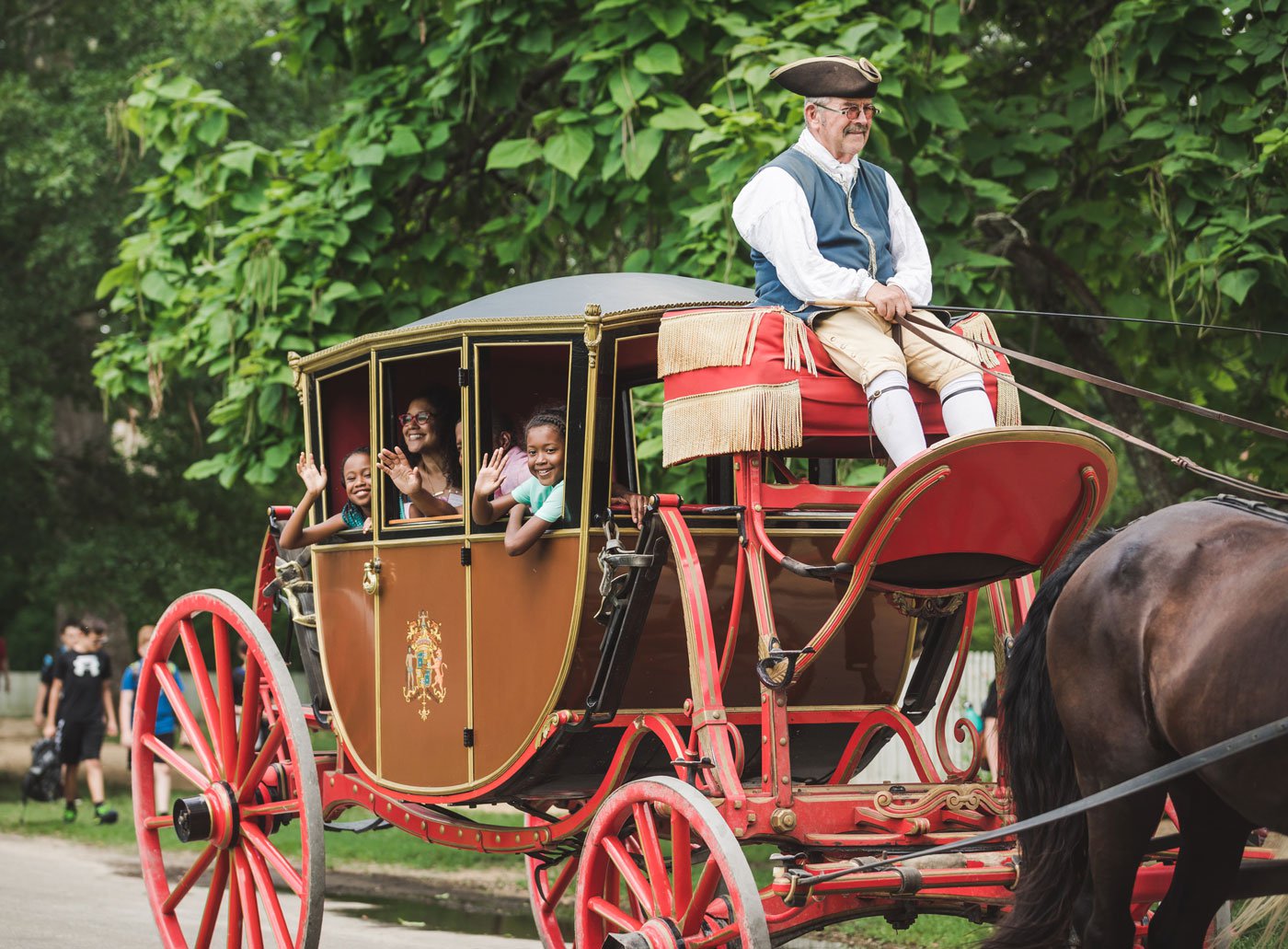
Colonial Williamsburg's newest vehicle (shown above) is a well-appointed, accurate
reproduction of an eighteenth-century traveling coach patterned after one owned
by Robert Carter, a resident of Williamsburg and one of the wealthiest Virginians
of the time. Carter's original coach was built by Joseph Jacobs Jr. at his shop
on St. Mary's Avenue in London. When the coach arrived in Leeds, Virginia, on
September 12, 1774, Philip Fithian, tutor to the Carter children, described
the coach as "a plain coach with the upper part black and the lower part
Sage or Pea Green." The new carriage features those same colors and was
crafted in Austria by carriage maker Florian Staudner.
The new coach and other reproduction vehicles are used in the Historic Area
to interpret eighteenth-century travel and transportation. The following simple
slideshow was created in PowerPoint and imported into QuickTime. It offers images
depicting the various modes of eighteenth-century travel, including several
Colonial Williamsburg vehicles.
Click on the image below to play the "18th-Century
Modes of Travel" slideshow. In order to view it you will need
the free QuickTime Player.
To learn how to create your own Quicktime movie/slideshow, visit the Technology Tips section of this E-Newsletter.