|
|
 |
  | 
 |
   |
 |
Teacher Resources
: Teacher Institute
: An 18th-Century Trades Sampler
|
|
 |
 |
| |
|
| |
a photographic essay by 1999 Colonial
Williamsburg Teacher Institute participants |
|
Introduction /
Apothecary /
Blacksmith /
Founder /
Harnessmaker /
Milliner
Printer & Bookbinder / Shoemaker /
Silversmith /
Wigmaker /
Summary
 |
Welcome to one of twelve shoemaking shops in Williamsburg in 1774. This
men's shoe shop was owned and operated by Mr. George Wilson. Today
you can see shoes being made using the same tools and techniques
used by the men and women of the 18th century. |
The customer enters the shop and requests a pair of
ready-made shoes hanging from the window or ceiling. However, if the customer finds
nothing to his liking, he can order shoes custom made to fit his feet. Measurements
are taken and the appropriate size last or wooden form is selected, the last is used
to shape the shoe, and the construction process begins. From start to finish, a well-trained shoemaker
completes a pair of shoes in eight to ten hours, or the equivalent of one work day. |
 |
 |
Once the shoe last is chosen, the customer selects a style of the latest
fashion. A pattern is cut and fit to the size of the last. The pattern is traced
onto the leather and cut out using a knife in a process called clicking. |
To free the hands of the shoemaker a leather strap is used as a vice to
hold the last in place. The next phase of shoe construction involves stitching the upper
to the innersole. The shoemaker's thread is made from several strands of flax coated
with pitch (pine tar) to waterproof it. A boar's bristle serving as a needle
is woven onto both ends of the thread. After stitching the upper to the innersole the
shoemaker cut a second piece of thick sole leather to form the outersole which was then
stitched to the innersole. |
 |
 |
A strong thick piece of leather is used to form the
outersole and thinner softer pieces are used for the upper and sides of the
shoe. The sole is fastened to the last with a few tacks. Then a hand held tool called
an awl is used to push holes into the leather to enable the shoemaker to stitch the
outersole to the upper. Finally, a heel, cut from scraps of thick sole leather,
was added in layers held in place by a series of wooden pegs. |
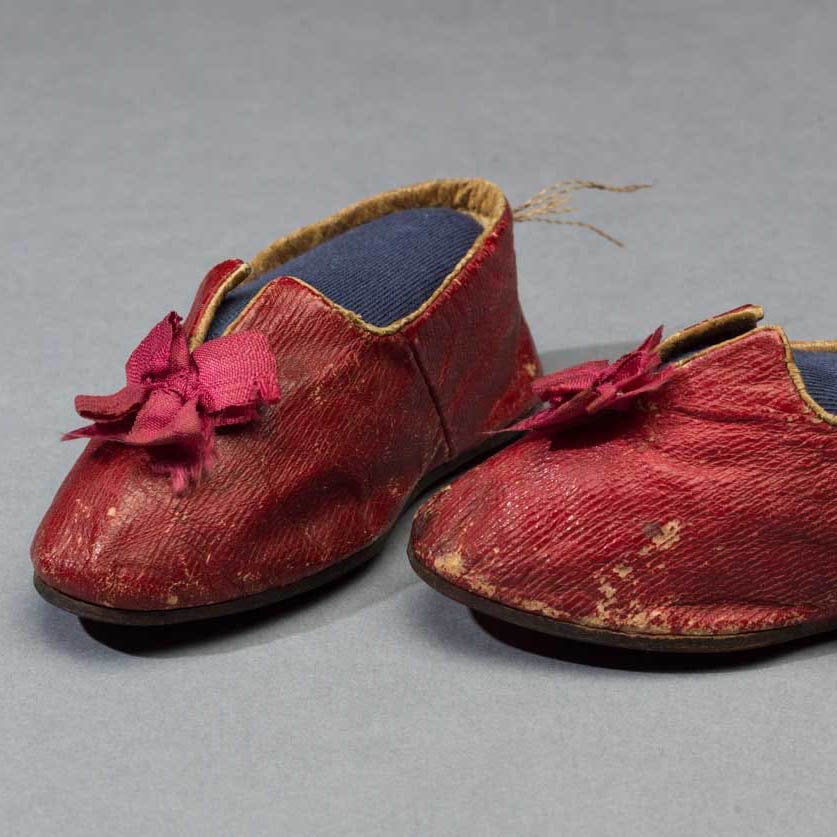
The finished shoes were displayed in the window at Mr.
Wilson's shoe shop. Although leather came in a variety of colors, black was the most
popular with the gentlemen of 18th-century Williamsburg. |
 |
Introduction /
Apothecary /
Blacksmith /
Founder /
Harnessmaker /
Milliner
Printer & Bookbinder / Shoemaker /
Silversmith /
Wigmaker /
Summary

|  |
|